What is mindfulness? Definition and practice
Mindfulness explained simply: its one-sentence definition, four stubborn misunderstandings, and the core move that meditation actually trains.
“Mindfulness” is everywhere and rarely defined. Yet it's simple: paying attention to the present moment, on purpose, without judging. Here's what that means concretely, what it is not, and how to practise it — in guided meditation and in real life.
Mindfulness, in one sentence
Mindfulness is paying attention to the present moment, on purpose, without judging what you find there. Three words, three demands: the moment (not the memory, not the scenario), the intention (you choose to be there), the absence of judgement (you welcome what is, discomfort included).
So it isn't a state of permanent calm, nor a way to "empty the mind". It is a way of paying attention — one that is learned, lost, and found again, dozens of times per session.
What it is not
It isn't emptying the mind
A mind that produces thoughts is a mind that works. You aren't trying to stop them — you notice them passing, and you come back.
It isn't a religion
The techniques come from contemplative traditions, but the practice today is entirely secular: everyone brings the meaning they want, or none at all.
It isn't forced positivity
Non-judgemental means exactly that. A hard day stays hard — you meet it as it is, which is very different from convincing yourself it's fine.
It isn't only for calm people
Busy minds are precisely the ones the practice serves most. "I think too much to meditate" is like saying "I'm too out of breath to run".
The core move: notice and return


The whole practice fits into one endlessly repeating cycle: attention rests somewhere — the breath, usually —, it wanders off, you notice that it wandered, you bring it back. That third beat, the noticing, is the key moment: it alone is what trains attention.
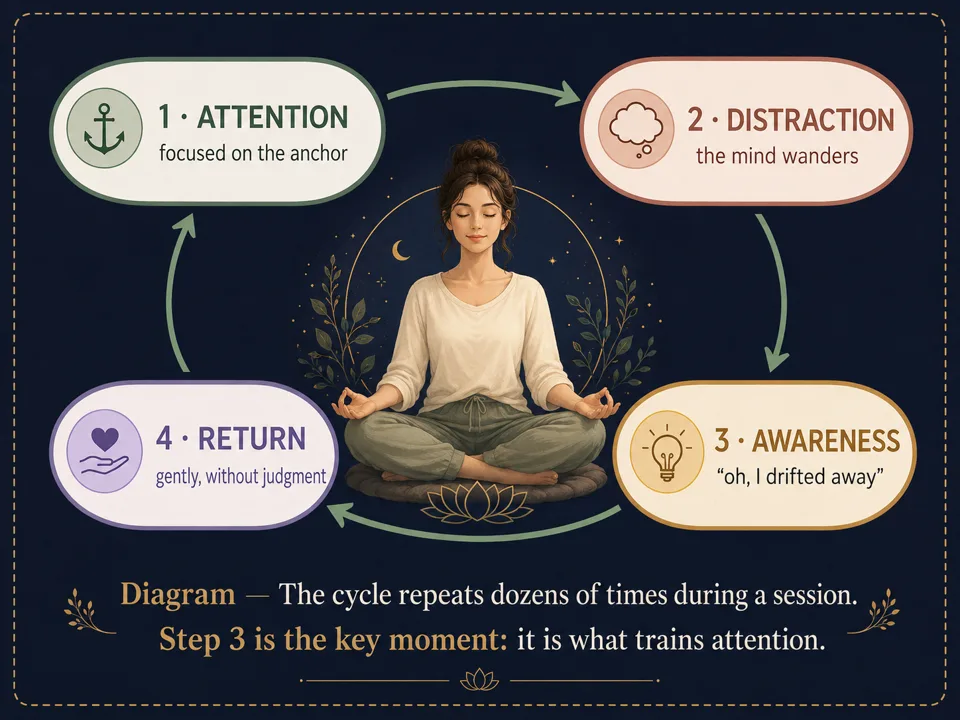
Hence the most useful reversal for a beginner: a mind that wanders often isn't failing often — it's training often. Fifty returns in one session are fifty repetitions.
Practising, formally and informally
Formal practice
Dedicated time, seated: 10 minutes of attention on the breath, or a guided mindfulness meditation — the body scan is its most accessible form. This is where the move gets installed.
Informal practice
The same move, slipped into an ordinary activity: feeling the water while washing up, truly listening to someone, walking while noticing your footfalls. Three conscious breaths before opening a door are enough — and that's where the practice really changes a day.
In MeditaDream, the Learning Basics category installs the move step by step and Body, Calm & Sleep extends it into full sessions — free, offline, no account.
Frequently asked questions
What's the difference between meditation and mindfulness?
Mindfulness is a way of paying attention; meditation is the dedicated time where you train it. You can be mindful while washing dishes — that's the informal practice.
Do I have to close my eyes?
No. Half-closed eyes with a soft gaze on the floor work very well — and are preferable if you tend to fall asleep or drift into imagery.
How long before I notice effects?
Relaxation shows up in the first sessions; a change in how you react day to day usually takes a few weeks of regular practice.
Rather practice than read?
Everything in this article can be practiced in MeditaDream, a free meditation app: 129 guided meditations and 17 immersive worlds, with no subscription, no ads, no account, and fully offline.
✦ Discover the free app