Yoga Nidra: The Waking Sleep That Can Feel More Restorative Than a Nap
Is 30 minutes of yoga nidra really worth 4 hours of sleep? What the research shows on sleep and stress, how NSDR differs, and a 10-minute session to try.
Sleeping without sleeping: the strange promise of yoga nidra
Lie down.
Stop moving.
A voice begins to guide your attention to:
- your right hand;
- your thumb;
- your index finger;
- your middle finger;
- your palm;
- your wrist.
Then your arm.
Then another area.
Your body gradually grows heavy.
You can still hear the voice.
But something shifts.
You’re not exactly asleep.
But you’re no longer in your usual waking state either.
Welcome to yoga nidra, literally associated with the idea of “yogic sleep.”
This practice has become hugely popular in meditation apps and relaxation programs because it promises something our era adores:
resting deeply without necessarily sleeping.
Online, yoga nidra is sometimes presented like this:
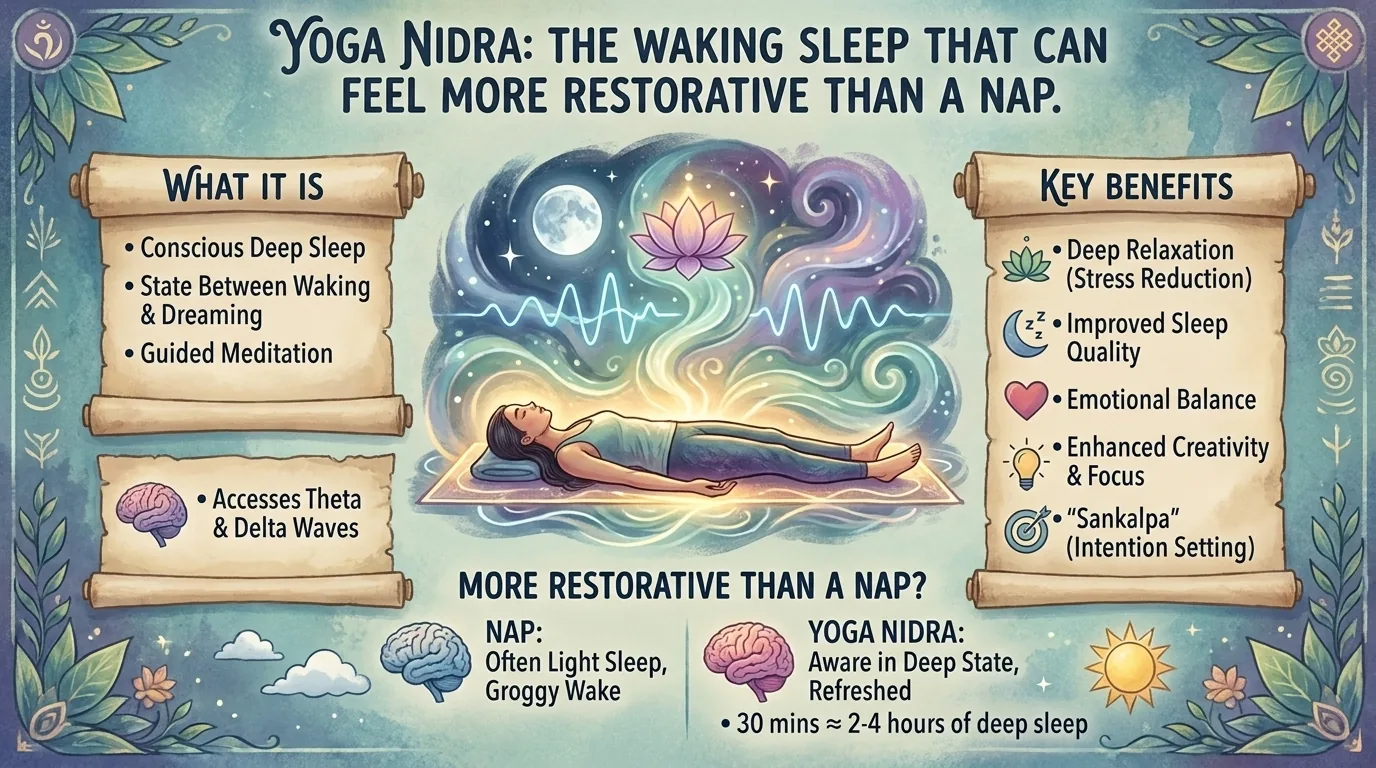
“30 minutes of yoga nidra equals four hours of sleep.”
This spectacular claim is everywhere.
It isn’t backed by solid data establishing a universal equivalence between a few dozen minutes of practice and several hours of physiological sleep.
Sleep has specific biological functions that guided relaxation doesn’t simply replace minute for minute.
But that doesn’t mean non-sleep deep rest is useless.
Quite the opposite.
Recent research on yoga nidra is becoming interesting enough that the practice deserves far better than an exaggerated slogan.
What does a real yoga nidra session look like?

There are several schools, but the most influential modern protocol in the West is often associated with Swami Satyananda Saraswati, founder of the Bihar School of Yoga.
The practice generally follows several stages.
Settling in
The practitioner lies down, often in shavasana.
The body needs to be comfortable enough that it no longer requires frequent movement.
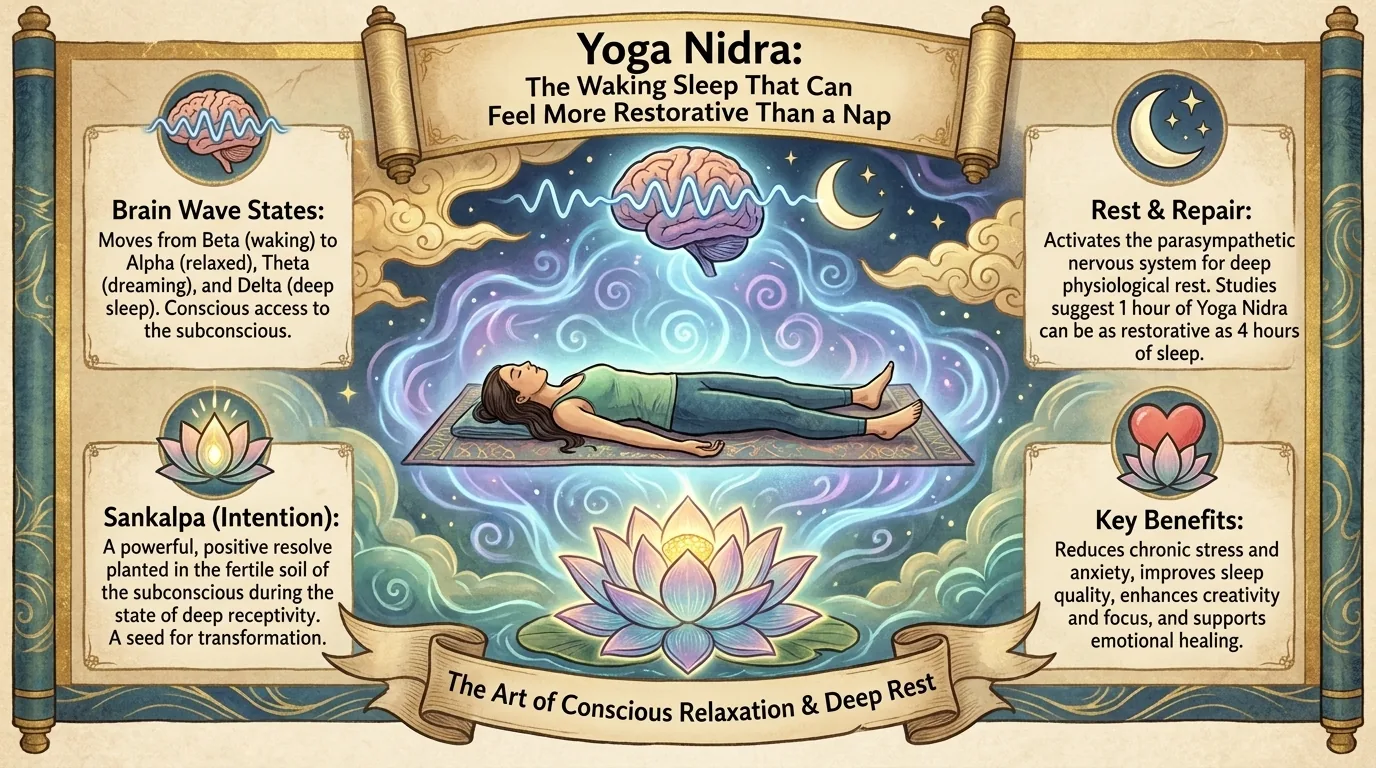
Sankalpa
The sankalpa is a short intention or resolve.
For example:
“I stay calm in the face of difficulty.”
Or:
“I take care of my energy.”
It is phrased briefly and repeated silently.
Rotation of consciousness
This is probably the most recognizable signature of yoga nidra.
Attention moves quickly from one area of the body to another.
Hand.
Arm.
Face.
Leg.
Back.
The instruction isn’t necessarily to move.
You feel the area mentally, then move on to the next.
Breathing
Attention may then follow the breath, sometimes with a countdown.
Opposite sensations
Some methods introduce pairs such as:
- heavy / light;
- warm / cold;
- comfort / discomfort.
Visualization
Images or scenes may be suggested.
Return to the sankalpa
The initial intention is repeated.
Gradual awakening
Attention returns to the body and the surroundings.
This structure already explains why a session can be so absorbing.
For twenty to forty minutes, the mind is continuously given a task simple enough that it doesn’t have to think, yet structured enough to keep it from drifting back fully into rumination.
Why is the body rotation so effective at calming mental chatter?
Try thinking about tomorrow’s meeting and the sensation in the tip of your right thumb at the same time.
You can manage it.
But your attention becomes divided.
Now add:
- index finger;
- middle finger;
- ring finger;
- little finger;
- palm;
- wrist.
Your brain has to keep updating the target.
So the rotation of consciousness occupies the attention channel.
Instead of saying:
“Stop thinking,”
which is generally a disastrous instruction,
yoga nidra says:
“Think of this now. Then this. Then this.”
The mind has a task.
Rumination has less room.
It’s very close to some body scan techniques, but with a particularly distinctive rhythm and structure.
At the same time, the body can reduce its muscle activity.
You then find yourself in an unusual situation:
very little movement + guided attention + low cognitive demand.
It’s the ideal mix for approaching a state of deep rest.
Yoga nidra and sleep: what does the research actually show?
The data are encouraging but still modest.
A systematic review published in 2026 identified six randomized trials totaling 244 participants, covering chronic insomnia, acute insomnia and various groups under particular constraints. Several studies reported improvements in sleep measures such as sleep onset latency, total sleep time or sleep efficiency. But the authors highlight great heterogeneity in protocols, along with a risk of bias that was often moderate to high.
Another systematic review with meta-analysis, published in April 2026, is even more cautious. Analyses of controlled trials on sleep quality and insomnia severity did not yield statistically significant results in some groupings, and the authors rate the overall certainty of the evidence as very low, mainly because of small samples and heterogeneity.
So the reasonable conclusion is:
yoga nidra is promising for sleep, but it can’t yet be presented as a well-established insomnia treatment on the same level as approaches backed by a much more robust clinical literature, particularly cognitive behavioral therapy for insomnia.
Less spectacular.
Far more useful.
What about stress and anxiety?
The recent data are interesting here too.
A systematic review and meta-analysis published in 2026 examined the effects of yoga nidra on stress, anxiety and depression across a much larger body of studies, with more than 5,000 participants counted in the review. The authors found favorable results in several analyses, while discussing the methodological limits and heterogeneity of the evidence.
Why might yoga nidra help?
Several components may contribute:
- comfortable stillness;
- body awareness;
- slowing down;
- breathing;
- a temporary break from outside demands;
- imagery;
- a repetitive ritual.
So it’s hard to say:
“Here is THE single mechanism of yoga nidra.”
Probably because there isn’t just one.
As is often the case with contemplative practices, the protocol works more as a whole.
Yoga nidra and NSDR: the same thing?

The term NSDR, for Non-Sleep Deep Rest, has become very popular in recent years.
It broadly refers to practices that let you reach deep rest without sleep.
Yoga nidra can fall into this category.
But NSDR is not a separate ancient yogic tradition.
It’s rather a modern, functional label grouping together certain deep relaxation practices, including yoga nidra.
So every form of yoga nidra is potentially a form of non-sleep deep rest.
But not everything called NSDR is necessarily traditional yoga nidra.
The difference matters, especially if we want to avoid rewriting history one hashtag at a time.
Should you stay awake during yoga nidra?
Traditionally, the aim is often to keep a certain thread of awareness.
But if you fall asleep, no yoga police will come knocking at your door.
If your goal is simply to sleep, drifting off during the session can even be perfectly fine.
However, if you want to explore yoga nidra as an awareness practice, try to keep a small part of your attention on the voice.
A few tips:
- practice earlier in the day;
- use a light blanket, but not too warm;
- bend one arm slightly to avoid sinking straight into sleep;
- practice on a mat rather than in your bed.
The idea isn’t to fight sleep.
Just to stay on its edge.
This state close to hypnagogia, where images and sensations start to change while awareness still persists, can become one of the most interesting aspects of the practice.
A ten-minute express session
Lie down.
Minute 1: settling in.
Feel the weight of your body.
Choose a very short intention.
Minutes 2–4: body rotation.
Right hand.
Arm.
Shoulder.
Left hand.
Left arm.
Face.
Chest.
Belly.
Pelvis.
Right leg.
Left leg.
Minutes 5–6: breathing.
Count ten out-breaths backward.
- 10.
- 9.
- 8.
If you lose count, simply go back to 10.
Minutes 7–8: opposite sensations.
Imagine your body heavy.
Then light.
Warm.
Then cool.
Minute 9: silence.
Do nothing.
Just listen.
Minute 10: coming back.
Repeat your sankalpa.
Feel your hands.
Your feet.
Your surroundings.
Then finish gently.
Ten minutes obviously don’t replace a night’s sleep.
But ten minutes in which you answer no one, scroll nothing and solve no problems are already a fairly serious form of neurological luxury.
Yoga nidra or a nap: which should you choose?
A nap involves actual sleep if you drift off.
Yoga nidra can stay entirely awake.
So they aren’t equivalent.
Choose according to what you need instead.
Slept five hours and feel exhausted?
Your body probably needs sleep more than a philosophy of rest.
Mentally overloaded but don’t want to sleep?
Yoga nidra can be ideal.
Got half an hour free but likely to wake up groggy after a nap?
Guided rest can be an interesting alternative.
The best tool depends on the problem.
And unlike wellness slogans, physiology loves nuance.
Frequently asked questions
Is yoga nidra equivalent to several hours of sleep?
No solid evidence supports a fixed equivalence such as “30 minutes = 4 hours of sleep.” Yoga nidra can promote deep rest, but it doesn’t replace the biological functions of sleep.
Can yoga nidra improve insomnia?
The research is promising but still limited. Recent reviews report improvements in some studies, while a 2026 meta-analysis rates the overall certainty of the evidence as very low.
Is it a problem to fall asleep during a session?
No. If your goal is relaxation or falling asleep, it can even be desirable. For more specific awareness work, simply try practicing at a time of day when you’re less tired.
What’s the difference between yoga nidra and NSDR?
Yoga nidra is a structured practice that comes from modern yoga and Indian contemplative traditions. NSDR is a broader contemporary label for various methods of non-sleep deep rest.
Rather practice than read?
Everything in this article can be practiced in MeditaDream, a free meditation app: 129 guided meditations and 17 immersive worlds, with no subscription, no ads, no account, and fully offline.
✦ Discover the free app