Walking to transform yourself: Compostela, Shikoku and pilgrims without religion
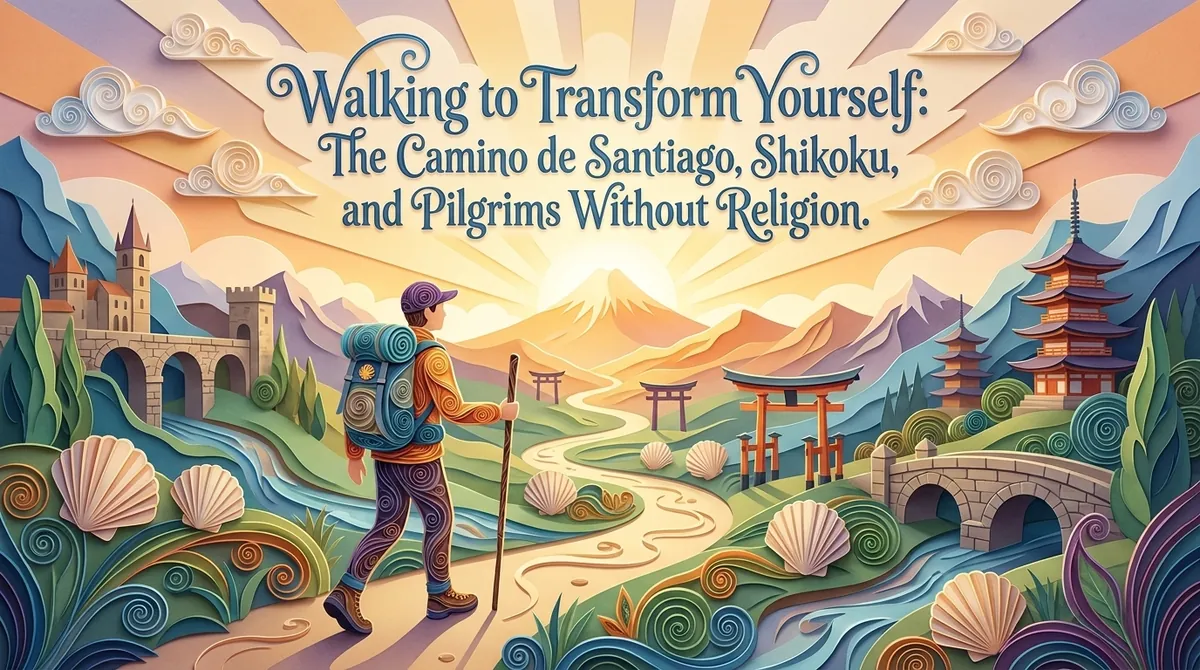
Why walk for weeks when you could drive? Explore the Camino de Santiago, the Shikoku Henro and how a one-day micro-pilgrimage can help you think clearly.
Why keep walking when no one is forcing you to go so slowly?
Our era has a fairly clear obsession: arriving faster. A ten-hour journey becomes eight, a response that took a week becomes instantaneous, a meal can arrive at home before you’ve even really decided what you want to eat, and yet thousands of people voluntarily choose to take several days or several weeks to cover on foot a distance that a vehicle could cover in a few hours.
At first glance, the pilgrimage on foot therefore seems like a logistical anomaly.
Why walk?
Because the goal is not just to arrive.
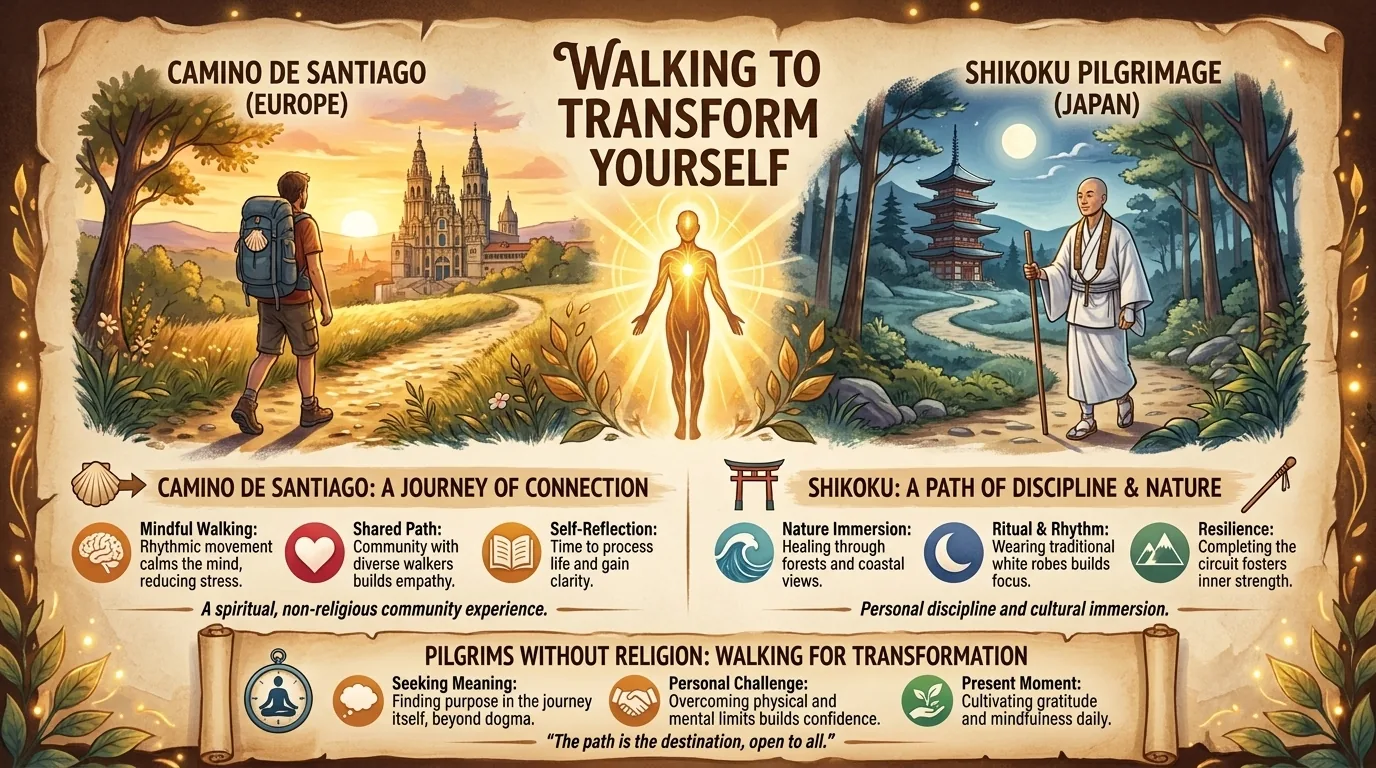
On the Camino de Santiago, historic routes converge on Santiago de Compostela, where the tomb traditionally attributed to the apostle James the Greater is located; UNESCO notes that Compostela became one of the great pilgrimage centers of the Christian world, and that the Camino Francés itself extends for approximately 738 kilometers across the Iberian Peninsula. (UNESCO World Heritage Centre)
In Japan, the Shikoku Henro links 88 temples associated with the figure of Kūkai, or Kōbō Daishi, founder of Japanese Shingon Buddhism; depending on the itineraries chosen, the complete walking circuit covers approximately 1,200 to 1,450 kilometers and generally requires several weeks. (Tourism Shikoku)
Two very different traditions.
Two very different religious stories.
Yet a surprisingly comparable bodily experience:
- you get up;
- you walk;
- you eat;
- you look for somewhere to sleep;
- then you start again.
Life, which yesterday had forty-seven priorities, suddenly has four.
This is perhaps the first transformation of the pilgrimage: the radical reduction of daily complexity.
Pilgrimage transforms time because the body finally imposes its own rhythm
When traveling by car or plane, the space between departure and arrival almost disappears. You leave a town, lock yourself in a machine, then reappear several hundred kilometers away.
On foot, nothing disappears.
Every kilometer exists.
A valley takes two hours.
A climb has a duration.
Rain is no longer a small weather pictogram, but something that gradually gets into your shoes.
This slowness produces an extremely different experience of time, particularly interesting for meditation, introspection and periods of personal transition.
After several days, the movement becomes repetitive:
- step;
- breathing;
- landscape;
- step.
You can think for an hour about an important decision.
Then stop thinking about it.
Then the question comes back the next day.
Walking thus provides something that our modern lives rarely provide: unstructured mental time long enough for a thought to move beyond its first layer.
You may begin the Camino by asking yourself:
“Should I quit my job?”
After three days:
“Why do I want to leave?”
After seven:
“What am I really trying to change?”
After ten:
“Maybe my problem isn’t just my job.”
Pilgrimage obviously has no automatic power of revelation.
You can walk five hundred miles and come back with exactly the same ideas.
But repetition, effort and reduced distractions create an exceptional context for a question to stop being simply intellectual.
We carry it physically for several days.
Compostela without being Christian: when the religious pilgrimage also becomes a personal quest
The Camino remains historically and symbolically a Christian pilgrimage, and erasing this dimension to present it as a simple personal development hike would be historically absurd; the roads, churches, hospices, crosses, traditions and final destination are directly linked to this religious history. (UNESCO World Heritage Centre)
But the contemporary motivations of walkers are much more diverse.
We meet people who are walking:
- out of faith;
- to mark a transition;
- after a separation;
- after a bereavement;
- in retirement;
- to take up a challenge;
- to think;
- or simply because they feel the need to leave for a while.
This is precisely what makes the concept of pilgrimage without religion interesting.
A pilgrimage may not be defined solely by what you believe.
It can also be defined by how you move.
You voluntarily leave a familiar environment.
You accept a constraint.
You go through several stages.
You depend more on the outside world.
You arrive at a place with meaning.
Then you come back.
This structure is very different from a tourist weekend.
The pilgrim not only asks:
“What am I going to see?”
but often:
“What state will I arrive in?”
This is a considerable nuance.
You can photograph Compostela Cathedral after getting out of a taxi.
Or look at it after thirty days of walking.
Architecturally, it is the same building.
Psychologically, it’s probably not the same place.
Shikoku: 88 temples and the strange feeling of never walking completely alone
The Shikoku pilgrimage has its own logic and should certainly not be turned into a “Japanese Compostela.” It is deeply linked to Kūkai, a major figure in Japanese Buddhism, and to a network of 88 temples whose current form gradually took shape over the course of history; documents mention the pilgrimage from the Middle Ages, while the precise circuit of the 88 temples seems to have been structured mainly between the end of the 16th and the 17th century. (Tourism Shikoku)
A particularly beautiful traditional formula accompanies the pilgrim:
dōgyō ninin, “the two of us travel together”.
The second companion is Kōbō Daishi.
Even when the pilgrim walks physically alone, tradition therefore reminds him symbolically that he is never totally alone; the first temple, Ryōzenji, is still presented today as the usual starting point for those following the classic order of the 88 temples. (Tourism Shikoku)
The circuit is also remarkably repetitive.
Entering a temple.
Purifying yourself.
Praying or reciting according to your practice.
Possibly receiving a seal.
Setting off again.
Then starting again.
What might seem monotonous is precisely one of the mechanisms of pilgrimage.
When the exterior structure becomes predictable, the interior variations become more visible.
Today:
impatience.
Tomorrow:
fatigue.
The next day:
wonder.
Then boredom.
Then gratitude.
The pilgrimage is not a permanent succession of spiritual revelations accompanied by a golden light.
A lot of it probably involves having sore feet.
And maybe it’s better that way.
A spirituality that only works when one is perfectly comfortable would risk having a fairly short lifespan.
Why walking can change something even without believing in a mystical transformation
Walking has several characteristics that are particularly interesting for mental well-being: moderate physical activity, exposure to natural or varied environments, potential reduction in screen time, repetitive rhythm and the opportunity for uninterrupted thinking.
But we must avoid the magic formula:
“Walk for thirty days and you will come back transformed.”
Some people come back profoundly changed.
Others mostly very tanned and with an impressive collection of blisters.
Transformation also depends on what you make of the experience.
A pilgrimage can function as a voluntary rite of passage.
Before:
an old situation.
During:
an in-between space where routines are suspended.
After:
reintegration into daily life.
This structure explains why pilgrimages are particularly attractive during:
- mourning;
- separation;
- career change;
- retirement;
- moving to another country;
- existential crisis.
When the old world no longer quite fits and the new one is not yet defined, walking offers a sufficiently concrete activity to carry you through this period of uncertainty.
You may not know what you are going to do with your life.
But today you know what to do:
go to the next village.
Sometimes that’s more than enough.
The micro-pilgrimage: create a day of walking that is not just a hike
You obviously don’t need forty days available to use certain principles of the pilgrimage.
Choose a destination that has meaning for you:
- a chapel;
- a monument;
- a forest;
- the grave of a loved one;
- the seaside;
- a summit;
- a place linked to your childhood.
Set off on foot from far enough away that the arrival really requires effort.
Before you leave, write just one question.
For example:
“What do I want to leave behind?”
During the first half of the walk, don’t look for the answer.
Just walk.
During the second, let the question come back if it comes up.
Upon arrival, stay ten minutes without your phone and write three sentences:
What I thought when I left.
What I understood while walking.
What I’m going to do when I come back.
This is your micro-pilgrimage.
No need to pretend to reproduce Compostela or Shikoku.
You are simply using their basic intuition:
some answers need physical distance before becoming clear.
The pilgrimage ultimately reminds us that there is a difference between knowing intellectually that life moves forward and feeling this progress in your own body.
For several days, the world shrinks to a few meters of path in front of you.
You don’t need to know the entire route.
Just the next step.
Cliché?
Yes.
But after a thousand kilometers, certain clichés earn the right to be taken seriously.
Frequently asked questions
Can you walk the Camino de Santiago without being a believer?
Yes. The Camino historically remains a Christian pilgrimage, but many contemporary walkers also have cultural, personal or introspective motivations; respecting the religious history of the path remains essential.
How long is the Shikoku pilgrimage?
The circuit of the 88 temples covers approximately 1,200 kilometers according to the walking route presented by the official Shikoku tourism body, with some detailed estimates exceeding 1,400 kilometers depending on the variants. (Tourism Shikoku)
Why does walking help you think?
It can reduce distractions, provides a repetitive activity and leaves long periods of unstructured thought, while adding the general benefits of physical activity and exposure to the environment.
Do you have to go away for several weeks to experience a pilgrimage?
No. A day of deliberate walking towards a meaningful place can already bring together the essential elements: intention, movement, effort, arrival and return.
Practice with the app
Rather practice than read?
Everything in this article can be practiced in MeditaDream, a free meditation app: 129 guided meditations and 17 immersive worlds, with no subscription, no ads, no account, and fully offline.
✦ Discover the free app