What Is Trance? A Human Ability Far More Normal Than You Think
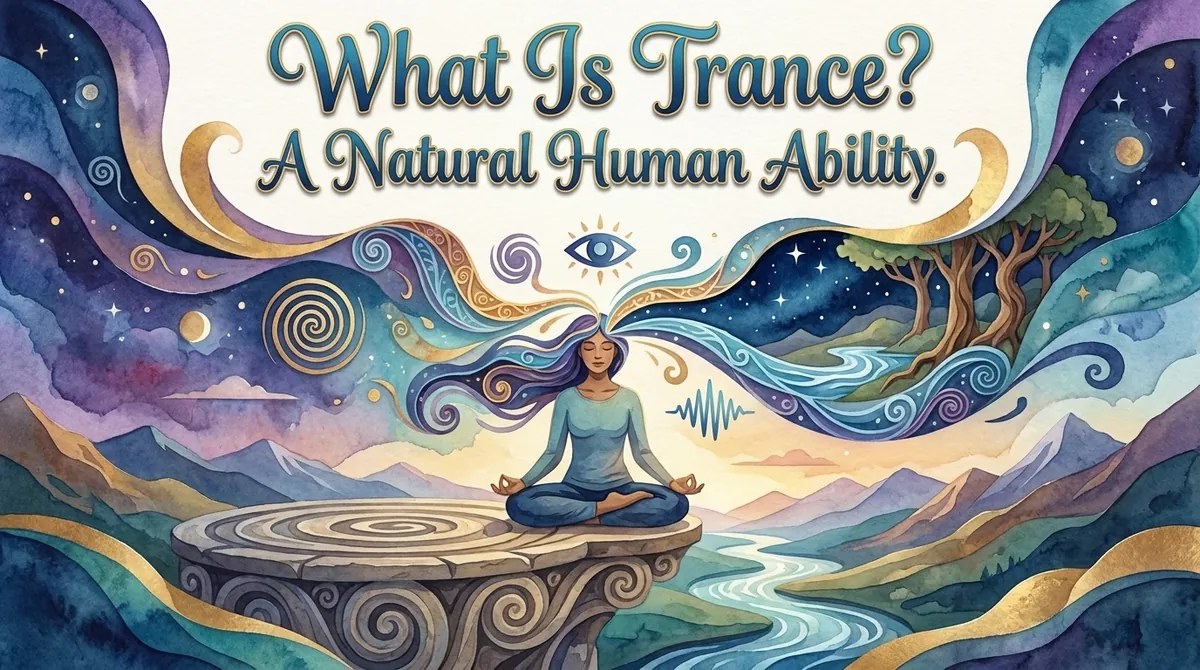
Trance is not only drums and stage hypnosis. See how absorption, rhythm and attention reshape consciousness, with a simple 10-minute exercise.
Trance Is Not Necessarily Someone Rolling Their Eyes Back While a Drum Explodes in the Background
The word trance tends to evoke rather dramatic images.
A shaman dancing around a fire. A hypnotized person staring into space. A mystic completely absorbed in prayer. A dancer who no longer seems aware of time. Or your uncle at a wedding after listening to the same song for the ninth time.
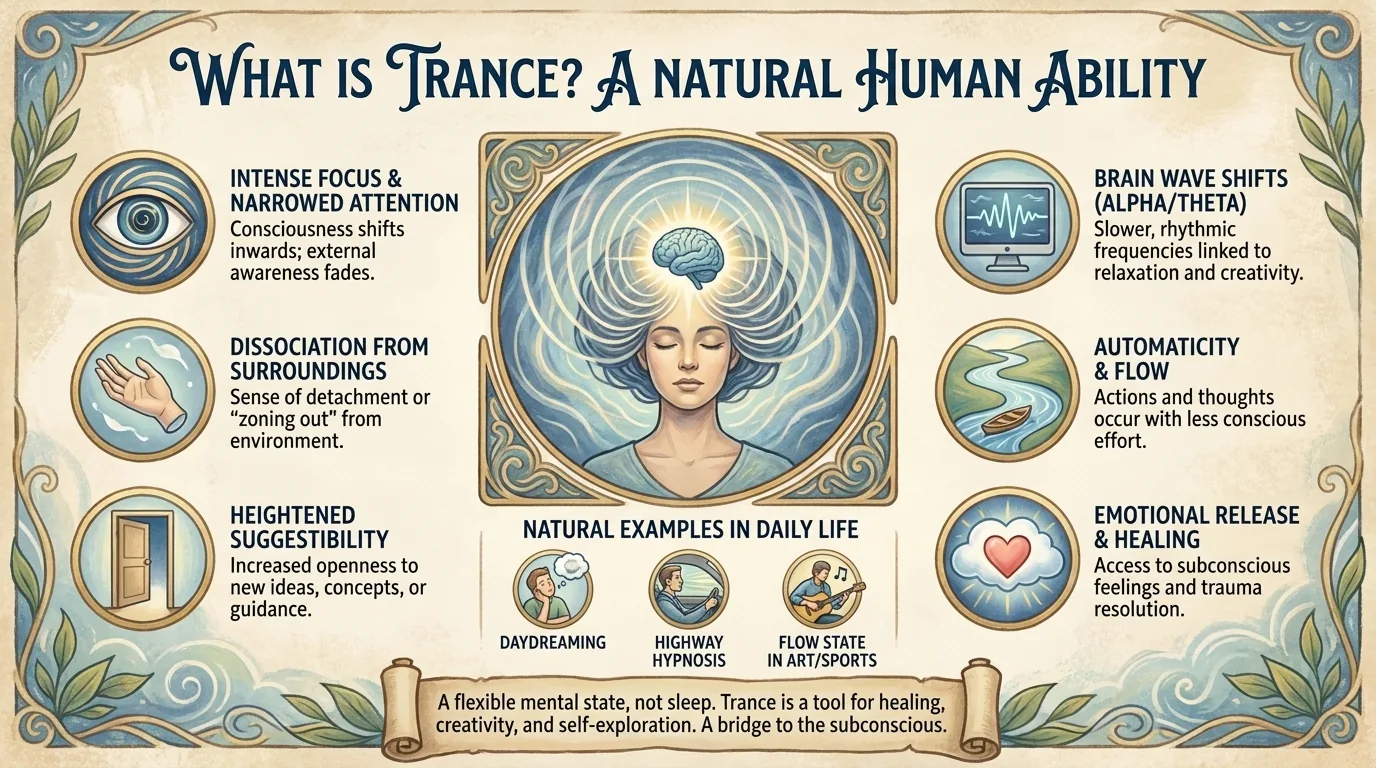
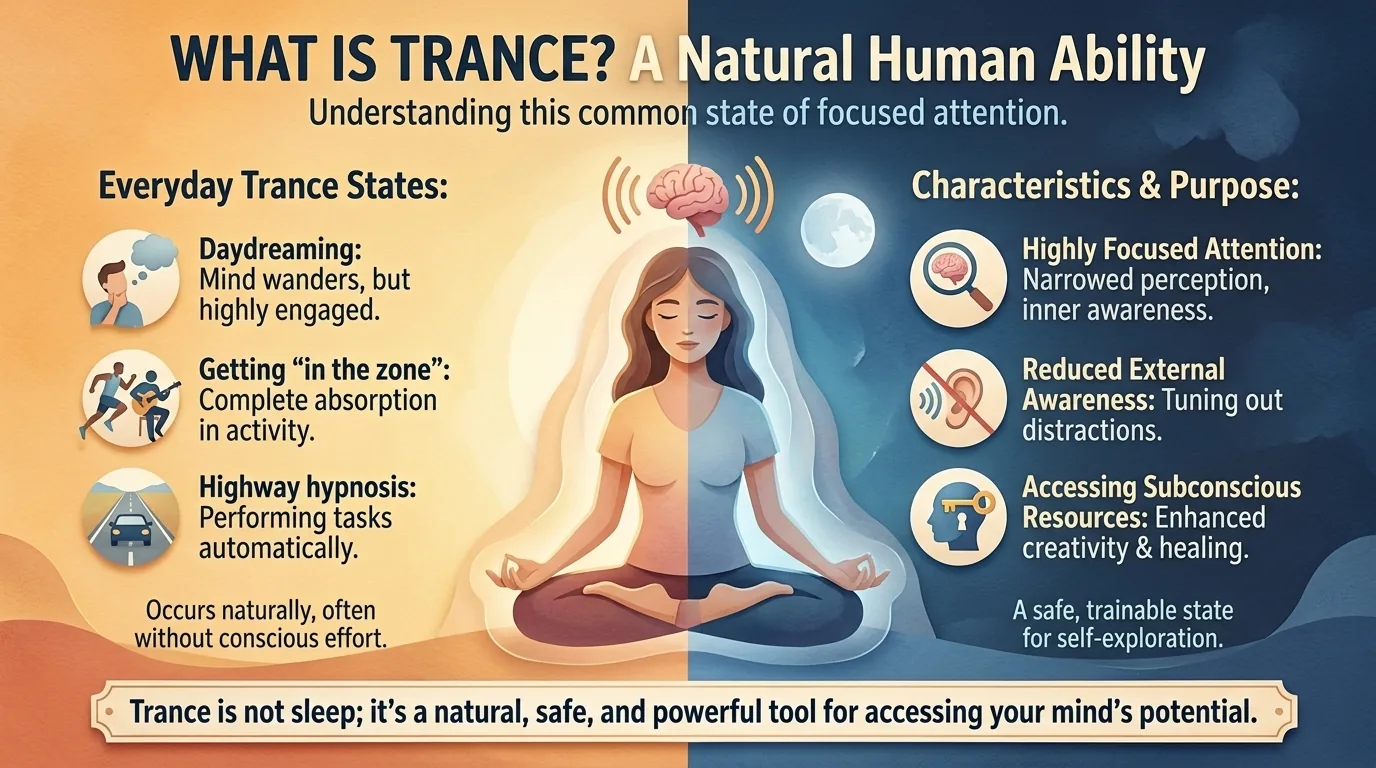
Yet trance, in its broadest sense, is far less exotic than that. Human beings have an extraordinary ability to become deeply absorbed in an experience.
Reading a novel and suddenly realizing that forty minutes have passed. Driving along a familiar road and noticing that part of the journey seems to have happened almost automatically. Becoming so immersed in music that the room around you seems to fade away. Working on a creative project and temporarily losing your sense of time.
These states are not identical to ritual, hypnotic, or shamanic trance. But they show something fundamental: ordinary consciousness is far more flexible than we usually imagine.
Attention can narrow. Body awareness can change. Time can speed up or slow down. External stimuli can become less important. Mental imagery can become more vivid. And none of that necessarily requires anything supernatural.
What Do Psychologists Mean by “Absorption”?

One particularly useful concept for understanding trance is absorption.
In psychology, absorption refers to a person’s tendency or ability to become intensely engaged in a sensory, imaginative, or attentional experience. Some people become completely immersed in music. Others can visualize scenes with remarkable intensity. Some are easily absorbed by stories, nature, meditation, or internal imagery.
The Tellegen Absorption Scale, developed in psychological research, measures this tendency.
Why does this matter? Because people who are naturally high in absorption may find practices involving hypnosis, guided imagery, meditation, ritual, or trance easier to enter.
Imagine attention as a spotlight. In ordinary consciousness, the spotlight is moving constantly: phone; sound; thought; body; memory; notification; itch on your nose; back to phone.
In absorption, the spotlight becomes much more stable. One experience occupies a larger proportion of the mental stage. That alone can profoundly change the quality of consciousness.
Trance and Hypnosis: The Same Thing?
Not exactly.
The term hypnosis generally refers to a context involving focused attention, reduced awareness of peripheral stimuli, and an increased capacity to respond to suggestion. Hypnosis can involve another person — a hypnotist — or be practiced as self-hypnosis.
Trance is a broader and more ambiguous term. Some researchers and clinicians use the word trance to describe the subjective state associated with hypnosis. Others prefer to avoid it because it can suggest that hypnosis is a completely separate state of consciousness, which remains scientifically debated.
Modern hypnosis research tends to focus less on the theatrical idea of someone being “under” another person’s control and more on mechanisms such as attention, expectation, suggestion, imagination, cognitive control, and absorption.
So no, a hypnotized person is not necessarily asleep. And no, the hypnotist has not hacked their brain remotely. Which is slightly disappointing if you were planning to become a supervillain.
Shamanic Trance: Rhythm as a Vehicle for Attention
In many ritual traditions, trance is deliberately encouraged through repetitive sensory stimulation: drumming, chanting, dancing, repetitive movement, breathing, music, and vocalization.
Sometimes fasting, sleep restriction, or psychoactive substances also appear in particular cultural contexts, although these practices obviously require very different levels of caution and should not be casually reproduced.
One of the best-known methods in contemporary shamanic practice uses repetitive drumming. The practitioner lies down or sits, closes their eyes, listens to a regular rhythm, and imagines entering another landscape.
Why might rhythm help? A repetitive sound reduces unpredictability. Attention can settle onto a stable sensory pattern. The repetition may also make ordinary environmental information less salient. Meanwhile, imagery becomes increasingly important.
This combination can produce an experience of profound absorption. Some practitioners describe the resulting experience as a journey into another reality. A psychologist may describe it as an altered state involving absorption, imagery, expectation, and modified sensory processing.
Again, these interpretations operate at different levels. The experience can be deeply meaningful without requiring us to settle the metaphysical question first.
What Happens to Time During Trance?
One of the most common characteristics of highly absorbed states is altered time perception. Ten minutes can feel like two. Or two minutes can feel surprisingly long.
This also happens during meditation, flow states, intense concentration, boredom, fear, and many other situations. Our sense of time is not produced by an internal Swiss watch. It depends partly on attention, memory, emotional state, and how many changes we perceive.
When your attention is completely absorbed by one activity, you may devote fewer cognitive resources to monitoring time. Then you look at the clock and say: “Wait. It’s already been an hour?”
Congratulations. You have just discovered one of the least mystical but most convincing demonstrations that subjective time is flexible.
Why Can the Body Feel Strange During Trance?
During deep relaxation, meditation, hypnosis, or trance, people sometimes report feeling extremely heavy; feeling unusually light; not knowing exactly where their hands are; feeling larger or smaller; floating; spinning; vibrations; warmth; numbness; or a sensation of movement while physically still.
These experiences can feel extraordinary. But the brain’s representation of the body is not fixed. It continuously integrates information from touch, vision, the vestibular system, proprioception, and interoception.
If you reduce movement, close your eyes, focus strongly on imagery, and remain still for a long time, the usual balance between these signals changes. The body can begin to feel different.
This is particularly relevant to practices involving shamanic journeying or astral travel, where altered body perception may become part of a larger spiritual interpretation.
The sensible rule remains the same: experience first, interpretation second.
Is Trance the Same as Dissociation?
Not necessarily.
The term dissociation covers a wide range of experiences involving some degree of disconnection between aspects of consciousness, memory, identity, perception, or bodily experience. Certain trance states may include dissociative features.
For example, a person may become less aware of their surroundings or feel temporarily detached from ordinary bodily sensations. But trance is not automatically pathological dissociation.
Context matters enormously. A deliberately induced twenty-minute ritual state from which you return comfortably is not the same thing as recurrent involuntary dissociation that interferes with everyday life.
This distinction is crucial. An altered state is not automatically a disorder. But neither should persistent distressing symptoms automatically be romanticized as spiritual progress.
Trance, Flow, and Meditation: Cousins, Not Identical Twins

The flow state, famously studied by psychologist Mihaly Csikszentmihalyi, occurs when a person becomes deeply immersed in an activity that presents an appropriate balance between challenge and skill.
Flow can involve intense concentration, reduced self-consciousness, altered time perception, and a sense that action and awareness are merging.
That sounds remarkably similar to certain descriptions of trance. But flow generally involves active engagement in a task. Meditative absorption may involve sustained attention with very little external activity. Hypnosis often adds suggestion. Shamanic trance adds a cultural, ritual, and cosmological framework. Ecstatic dance adds movement and rhythm.
The experiences overlap. They are not interchangeable. Think of them as neighboring countries with extremely porous borders.
Can Brain Activity During Trance Be Measured?
Yes — but this is where we need to avoid oversimplification.
Studies of hypnosis, meditation, ritual trance, and related altered states have identified changes in brain activity and connectivity. However, there is no single “trance brainwave” that proves someone has entered a universal trance state.
Depending on the practice, researchers may observe changes in networks involved in attention, self-referential processing, executive control, sensory processing, and body awareness.
Different altered states can produce different patterns. Even within hypnosis, individual differences are significant.
So the internet claim “Trance happens when your brain enters exactly X Hz” is generally much more confident than the science allows.
Brain rhythms such as alpha and theta activity are interesting. They are not secret passwords to another dimension.
A Simple 10-Minute Trance Exercise for Beginners
You do not need a drum, incense, feathers, or a cave. Although admittedly the cave would improve the atmosphere.
Sit or lie down comfortably. Choose a repetitive sound. It could be a metronome, a steady drum track, the sound of rain, your breathing, or a repeated neutral syllable.
- Minutes 1–2: Relax your body. Feel the surface beneath you.
- Minutes 3–5: Focus almost entirely on the repetitive sound. When thoughts appear, let them pass and return to the rhythm.
- Minutes 6–8: Imagine a simple repetitive movement. Walking down a path. Descending a staircase. Following a river. Do not try to create a spectacular vision. Allow the scene to develop gradually.
- Minute 9: Stop deliberately constructing the imagery. Observe what appears spontaneously.
- Minute 10: Return to your breathing. Move your fingers. Move your feet. Open your eyes. Look around the room. Name three objects.
The return phase matters. A good trance practice should include both an entrance and an exit. Otherwise, you have built a very elegant door and forgotten the handle on the other side.
How Do You Know Whether You Were “Really” in Trance?
There is no universal test.
You may have noticed less awareness of the room, stronger mental imagery, altered time perception, greater absorption, unusual body sensations, or reduced internal commentary. Or perhaps you simply felt relaxed. That is fine.
Do not turn trance into another performance goal. The paradox is that trying too hard to enter trance often makes it harder. Part of the process involves allowing attention to become absorbed rather than constantly checking: “Am I there yet?”
Imagine trying to fall asleep while asking yourself every fifteen seconds: “Am I asleep now?” Same problem.
The Most Useful Way to Think About Trance
Trance does not have to be understood as a mysterious switch between “normal consciousness” and “another dimension.”
A more useful model is to imagine consciousness as adjustable. Attention can become narrower or broader. Mental imagery can become weaker or stronger. Body awareness can move into the foreground or background. The sense of self can become more or less prominent. Time can feel different. The external world can become more or less salient.
Trance is one family of experiences created by moving several of these sliders at once.
Traditional cultures built rituals around this human capacity. Modern psychology studies parts of the mechanism. Meditators deliberately train certain aspects of it. Artists sometimes enter it accidentally. Children probably do it while playing without needing a single book on altered states of consciousness.
So trance may be exotic in its rituals. But the underlying human capacity is remarkably ordinary. And that may be the most fascinating thing about it.
Frequently asked questions
What Does Being in a Trance Feel Like?
People often describe deep absorption, altered time perception, reduced awareness of the surroundings, vivid imagery, unusual bodily sensations, or a feeling of being completely immersed in an experience.
Is Trance Dangerous?
Gentle trance practices based on relaxation, repetitive sound, and visualization are generally low intensity. However, practices involving extreme breathing, prolonged sleep deprivation, psychoactive substances, or severe dissociative symptoms require much greater caution.
Can Anyone Enter a Trance?
Most people are capable of some degree of absorption, although susceptibility to hypnosis and the ease of entering deeply absorbed states vary considerably between individuals.
Is Trance the Same as Meditation?
No. Some meditation practices can produce trance-like absorption, but meditation is a much broader category and can also involve very clear, open awareness rather than narrowed absorption.
Practice with the app
Rather practice than read?
Everything in this article can be practiced in MeditaDream, a free meditation app: 129 guided meditations and 17 immersive worlds, with no subscription, no ads, no account, and fully offline.
✦ Discover the free app