How to do walking meditation when you can't sit still
How to do walking meditation: the three phases of a step, the route to walk and three ways to practice it on days when stillness won't work.
When sitting is impossible — restless body, protesting back, a mind spinning too fast — walking meditation takes over. Movement absorbs restlessness instead of fighting it, and the feet on the ground give attention a more tangible anchor than the breath.
Meditating without sitting down
Some days sitting is impossible: the body is too restless, the back protests, the mind spins too fast to stay put. Walking meditation exists for exactly those days — and it isn't a fallback: it's a complete practice, taught for centuries in contemplative traditions.
Its advantage is twofold. Movement absorbs restlessness instead of fighting it, and the sensations of the feet on the ground give attention a far more tangible anchor than the breath. Many people who "can't do it sitting" discover meditation by walking.
The three phases of a step
Each step breaks into three beats, which you follow inwardly. That's the whole exercise:
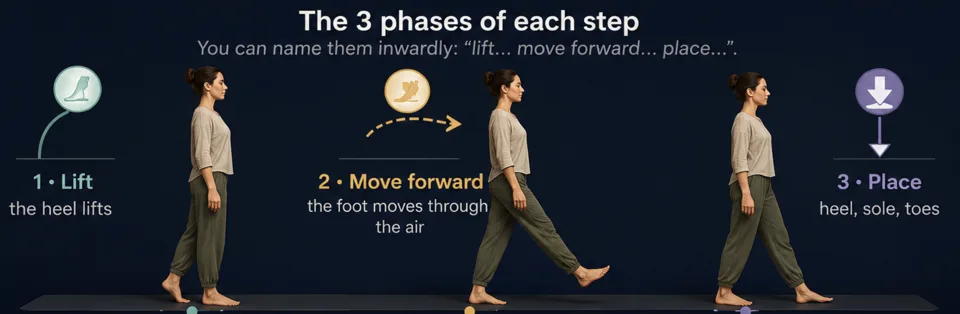
- Lift — the heel leaves the ground, weight shifts to the other leg.
- Move — the foot travels through the air, knee soft.
- Place — the foot meets the ground, weight returns, the base reforms.
Walk much more slowly than usual: three or four times slower. Gaze resting three metres ahead, hands wherever you like — behind, in front, alongside. When the mind leaves, return to the phase you're in, exactly as you'd return to the breath.


Three ways to practice walking meditation
- The slow version — 10 to 20 minutes on a short route, at the pace described above. The closest to seated meditation.
- Mindful walking — normal pace, outdoors: you notice the footfalls, the air on your skin, the sounds, without naming the phases. Ideal for the morning commute.
- The emergency version — three minutes in a corridor when tension rises: the body discharges through movement while attention re-centres.
In MeditaDream, walking itself isn’t narrated step by step, but the 4 Minutes category offers short sessions to play outdoors, between two journeys — free and offline, which matters when you're outside with no signal.
Frequently asked questions
Where can I practise walking meditation?
A hallway, a room, a garden: ten to fifteen steps then turn around. The short route is an advantage — there's nowhere to get to, so nothing to anticipate.
How fast should I walk?
Three to four times slower than usual for the formal version. Outdoors at normal pace it becomes mindful walking: you notice, without naming the phases.
Is it as effective as sitting meditation?
It's a complete practice, not a discount substitute. For restless minds and bodies that won't stay put, it's often more effective than sitting.
Practice with the app
Rather practice than read?
Everything in this article can be practiced in MeditaDream, a free meditation app: 129 guided meditations and 17 immersive worlds, with no subscription, no ads, no account, and fully offline.
✦ Discover the free app