
In short
Guided imagery is a practice in which you follow a guide's words to create detailed mental images, using all your senses. You might see a beach, hear the waves, feel warm sand and smell salt in the air. It is used for relaxation, mental rehearsal and meditation, and it can be learned like any other skill.
What is guided imagery?
Guided imagery is deliberate mental imagery: you build an inner scene on purpose, led by words. The word imagery can mislead, because it is not only visual. A good guided imagery meditation includes sounds, textures, temperatures, smells and movement.
Mental imagery is something you already do all day. You picture the route to a friend's house, replay a conversation, imagine the taste of a meal. Guided imagery takes that natural ability and gives it a direction.
In psychology, mental imagery has been studied for a long time. In 1880, Francis Galton asked people to picture their breakfast table that morning and describe how vivid the image was. Their answers varied enormously, from almost photographic to nearly nothing.
Guided imagery, creative visualization, visualization meditation
These terms overlap, and people often use them interchangeably. Each one, though, has its own flavor.
- Guided imagery
You follow a guide, in person or in audio, through a scene. The emphasis is on rich sensory detail and relaxation.
- Guided visualization
Often used as a synonym. In meditation apps, it usually means a guided scene with a clear intention, such as a walk in a forest.
- Creative visualization
Made popular by Shakti Gawain's 1978 book of that name. You imagine a goal as already reached, to clarify what you want and stay motivated.
- Visualization meditation
Imagery used as an anchor for meditation. You hold one image steadily, like a candle flame or a mandala, to train attention.
The power of visualization: what research shows
Research on motor imagery, imagining a movement without performing it, shows that it engages many of the same brain areas as the real movement. This is one reason mental rehearsal can support learning a skill.
Athlete visualization is the best-known example. Many athletes rehearse a race, a dive or a serve in their minds before they compete. Sport visualization does not replace physical training. Athletes use it alongside, to prepare, to stay focused and to arrive feeling at home in the situation.
Positive imagery, picturing calm or pleasant scenes, is widely used for relaxation, and researchers keep studying when and how it helps. The honest summary: visualization is a real mental skill, rooted in how the brain works. It is not a magic trick.
How do I visualize if I can't see images? Aphantasia
Some people see almost nothing when they close their eyes. In 2015, the British researcher Adam Zeman and his colleagues gave this a name: aphantasia, the absence of voluntary visual imagery. At the other end of the spectrum, some people's images are almost as vivid as real sight.
Most people fall somewhere in between, and imagery varies from one sense to another. You might see little but hear clearly, or feel textures vividly. If your visual images are faint, guided imagery still works. Lean on sound, touch and movement, or simply on knowing where you are in the scene.
How to visualize better: one sense at a time
The most reliable way to train imagery is to work sense by sense, then combine them. This is the progression of the Visualization category in MeditaDream, six sessions of 16 to 29 minutes.
You start with sight: in Film — a Butterfly Flies Beside You, you follow a butterfly's path and the gust that pushes it off course. Touch comes next, with Touch — the Key in Your Hand: its weight, its coldness, the slight pull when you lift it. Then hearing, with Hearing — the Distant Singing Bowl, where you follow both distance and direction.
Finally, two long sessions bring the three senses together, on the summit of an extinct volcano and in a spaceship's cockpit. The Room You Know asks you to rebuild a familiar room and let the evening light fall into it. When you feel ready, the Third Eye category goes further, with images that appear on their own.
- 1Sight
Follow a butterfly flying beside you: its path, its small corrections, the gust that pushes it off course.
Film — a Butterfly Flies Beside You · 18 min - 2Touch
Feel a key resting in your open hand: its weight, its coldness, the slight pull when you lift it.
Touch — the Key in Your Hand · 17 min - 3Hearing
Listen to a singing bowl approaching from afar, and follow both its distance and its direction.
Hearing — the Distant Singing Bowl · 16 min - 4All three senses together
Build a complete landscape with sight, hearing and touch, at the summit of a volcano or aboard a ship exploring the galaxy.
Bringing the Three Senses Together — Summit of a Volcano · 29 min
The progression of the Visualization category: one sense at a time, then all three together.
Visualization exercises and guided imagery examples
These visualization techniques take a few minutes each, and you can try them today. Do them seated, with your eyes closed, and start with the one that appeals to you most.
- The lemon
Picture a lemon in your hand. Feel its weight and its skin, cut it, smell it, bring it to your lips. Notice whether your mouth reacts.
- The familiar room
Walk through your bedroom in your mind. Count the objects on a shelf, open a drawer and notice the light.
- The object study
Look at a simple object for thirty seconds, close your eyes and rebuild it. Open your eyes, compare and repeat.
- The sound map
Imagine a bell ringing far to your left, then closer, then to your right. Follow its position as it moves.
- The full scene
Choose a place you love and add one sense at a time: sight, then sound, then touch, then smell.
When to use guided imagery in daily life
Guided imagery is not only for long meditations. A few minutes of positive imagery can change the tone of a day. Guided imagery for stress relief is one of its most common uses. The 4 Minutes category in the app offers several sessions built on this idea.
- Before a challenge: Finding Your Confidence Before a Challenge, 4 minutes, recalls a gesture you already got right.
- During a break: Your Instant Refuge, 4 minutes, opens a small place of your own where worries can wait.
- On a gray day: A Happy Memory Through Three Senses brings back a good moment through sight, sound and feeling.
- When ideas are stuck: Creative Unblocking, 26 minutes, quiets the inner critic and lets ideas come.
- In the evening: a world such as The Zen Garden invites you to slow down before the night.
Safe place visualization: your inner sanctuary
Safe place visualization is one of the classic guided imagery exercises. You build an inner place where you feel completely at ease: a beach, a forest, a room, a mountain. With practice, simply recalling it can bring back a sense of calm.
Make it precise. What is the ground made of? What sounds are there? Is there a smell, a temperature, an object you like to touch? Some people add a protective symbol, or a presence that keeps them company.
In the app, Your Sanctuary lets you describe this place in detail, from its colors and sounds to an entrance ritual and a return phrase. The worlds also offer ready-made sanctuaries, like The Floating Island, a small island of your own above the clouds. To explore them all, see the immersive meditation worlds.
Manifestation visualization: an honest look
Manifestation visualization is popular online: picture what you want clearly enough, and it will come. Visualization cannot make things appear. Research by psychologist Gabriele Oettingen even suggests that dreaming only of the happy ending can sap the energy to act. Picturing the obstacles as well helps people move forward. She calls this method WOOP: Wish, Outcome, Obstacle, Plan.
Future Self, in Consciousness & Trance, follows this approach: you live the direction you want in imagination, then draw a first concrete step from it. Manifestation journaling can follow the same logic: write down the wish, the likely obstacle and your first step. Used this way, visualization helps in three real ways:
- It clarifies what you actually want, by turning a vague wish into a concrete picture.
- It lets you rehearse the steps, the way an athlete prepares a race.
- It keeps your motivation alive on days when the goal feels far away.
Guided imagery meditation in MeditaDream
The Visualization category is built as a training of the inner senses: sight, touch, hearing, then all three together. Bringing the Three Senses Together — Summit of a Volcano lasts 29 minutes, and The Room You Know 27 minutes.
Once your images feel steadier, the five advanced sessions of the Third Eye category, such as The Image that Appears on its Own, take you further. The 17 worlds then turn guided imagery into a full journey, from The Zen Garden to Underwater Atlantis. Everything is free and plays offline once downloaded.
Categories
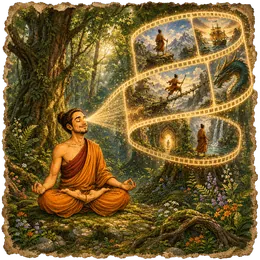 Visualization6 sessions · 16 to 29 min · intermediate
 Third Eye5 sessions · 22 to 26 min · advanced
 Mini Adventures4 sessions · 17 to 34 min · intermediate
Sessions to try first
- Film — a Butterfly Flies Beside You18 min · intermediate · VisualizationFollow a butterfly with your eyes, in imagination: its path, its corrections, the gust that pushes it off course.
- Touch — the Key in Your Hand17 min · intermediate · VisualizationA key resting in an open hand: its weight, its coldness, the slight downward pull when you lift it.
- Hearing — the Distant Singing Bowl16 min · intermediate · VisualizationA singing bowl approaching from afar: follow both its distance and its direction, with the inner ear alone.
- Bringing the Three Senses Together — Summit of a Volcano29 min · intermediate · VisualizationAt the summit of an extinct volcano, build a complete landscape with sight, hearing and touch together.
- The Room You Know27 min · intermediate · VisualizationRebuild a room you know by heart, then let the evening light fall into it, shadow after shadow.
Tools in the app
- Your Sanctuary
Describe your inner safe place: its environment (Forest, Ocean, Temple, Cave, Mountain, Sky, Void or Custom), colors, sounds, objects and return phrase.
- Meditation Worlds
Enter one of the 17 worlds for a complete guided visualization of 13 to 19 minutes, then note it with Capture this.
- Meditation history
After a session, write down what came to you in Images & symbols, and look back at how your images change over time.
- The Oracle
Type how you feel and receive three cards, each one a matching meditation.
Related immersive worlds
 Journey Through the Galaxy
 Underwater Atlantis
 The Ancient Temple
Frequently asked questions
What is guided imagery?
Guided imagery is a relaxation and meditation technique in which you follow a guide's words to build a detailed inner scene. It uses all the senses: sight, sound, touch, smell and movement. People use it to relax, to rehearse a skill or an event, and to explore their inner world. It is a learnable skill that grows with regular practice.
What is mental imagery?
Mental imagery is the ability to experience something in your mind without it being there: seeing a face, hearing a song, feeling the weight of a bag. It involves all the senses, not only sight. Its vividness varies widely from person to person. Some people have almost lifelike images, while others have nearly none, a trait called aphantasia.
How can I visualize better?
Work one sense at a time, starting with the one that comes most easily. Use familiar subjects, like your own room, before imaginary ones. Keep sessions short and relaxed, because straining tends to dim images. Describe the details to yourself in words. With regular practice, most people find their inner scenes become steadier and richer.
How do I visualize if I can't see images?
You are not alone. Some people have little or no visual imagery, a trait called aphantasia, named by Adam Zeman's team in 2015. You can still practice guided imagery through other senses: sounds, textures, temperature, movement, or simply knowing where things are in the scene. Many people with faint images still find guided imagery relaxing.
Does visualization work?
It depends on what you expect. Imagining a movement engages many of the same brain areas as doing it, which is why athletes use mental rehearsal. Calm imagery is widely used for relaxation. But visualization does not make things happen on its own. It works best as preparation, motivation and focus, combined with real action.
How do athletes use visualization?
Athletes use visualization to rehearse a performance in detail before it happens: the start of a race, a jump, a free throw. They imagine the movement, the sensations and the setting, and sometimes possible problems and their response. Sport visualization complements physical training. It helps them prepare, stay focused and feel familiar with the situation when the moment comes.
What is creative visualization?
Creative visualization is the practice of imagining a goal or a desired situation as vividly as possible. Shakti Gawain popularized it with her 1978 book, Creative Visualization. Used well, it helps you clarify what you want and stay motivated. It works best when you also picture the steps and the obstacles, then act on them.
What is a safe place visualization?
A safe place visualization is a guided imagery exercise in which you build an inner place where you feel calm and protected. You fill it with details for every sense. Once it is familiar, you can return to it in a few breaths. In MeditaDream, Your Sanctuary lets you describe this place and keep it on your phone.
Can you use guided imagery for sleep?
Many people do. At bedtime, a slow and simple scene gives racing thoughts something gentle to follow. Keep it calm: a warm beach, slow waves, your own breath. Avoid exciting journeys. In MeditaDream, the worlds end with a gentle return, so for falling asleep, choose Drifting into Sleep, a 16-minute session with no wake-up at the end.
Visualization on the blog
Articles to help you build richer inner images, one sense at a time.
Coming soon
- Coming January 4, 2027Archetypes in meditation: symbols and inner worlds
Practice for free
Every session is in the MeditaDream app: free, no subscription, no ads, no account, and it works offline.
✦ Discover the app