
In short
Qigong is a Chinese practice that combines slow movement or still postures, regulated breathing and focused attention. The name joins qi, meaning breath or vital energy, and gong, meaning work or skill. It is often translated as “energy work.” Also spelled qi gong, chi gong or chi kung, it is practiced for calm, balance and self-cultivation.
What is qigong? The meaning of qi and gong
Qi (气) is one of the central ideas of Chinese thought. The character first evoked vapor or breath. Over time, it came to mean the vital energy that animates all living things. Many English speakers write it chi, which is why you will see “chi energy” and “chi gong.” Chi and qi are simply two spellings of the same word.
Gong (功) means work, skill or achievement: something gained through steady effort. The same word appears in kung fu, gongfu in Chinese. Qigong is therefore the art of cultivating qi, the breath and energy of life, day after day.
The spellings vary with the system used to write Chinese in Latin letters. Qigong and qi gong follow pinyin, the system used in China today. Chi kung comes from the older Wade-Giles system, and chi gong mixes the two.
A short history of qigong
The practice is far older than its name. Ancient Chinese texts describe daoyin, “guiding and pulling,” exercises that combine movement and breath. A painting on silk found in a Han dynasty tomb at Mawangdui, sealed in 168 BCE, shows dozens of figures performing them.
Over the centuries, Daoist, Buddhist and martial traditions each developed their own methods. Famous sets emerged along the way. The Five Animals Frolics is attributed to Hua Tuo, a celebrated figure of the late Han dynasty. The Ba Duan Jin, or Eight Brocades, is attested since the Song dynasty.
The word qigong itself was popularized in China in the 1950s, as a common name for these many practices. It later spread around the world. In the app, The Taoist Sanctuary in the Mountains, in Sacred Places, takes you to such a retreat at dawn, above a sea of clouds.
The three regulations: body, breath and mind
Chinese teachers often sum up qigong in three regulations, or tiáo. You regulate the body, the breath and the mind, and the practice happens when all three come together.
No single one is enough on its own. A perfect posture with a restless mind is just exercise. A calm mind in a slumped body is just rest. Qigong lives where the three meet.
Chinese tradition also has energy centers of its own, the dantian. The lower dantian, below the navel, is where many exercises gather attention, much as Indian traditions work with the 7 chakras.
- The bodytiáo shēn
Find a posture that is upright and relaxed at once: feet rooted, knees soft, shoulders loose.
- The breathtiáo xī
Let the breath become slow, smooth and deep, usually through the nose, without forcing it.
- The mindtiáo xīn
Gather your attention, often in the lower belly, and keep it calm and present.
Body, breath and mind are regulated together: qigong happens where the three meet.
Main types of qigong, from moving sets to qigong meditation
There are many qigong styles, but they fall into a few broad families. Most of them mix several of these aspects. Even a moving qigong workout stays gentle: the effort is slow and turned inward.
- Moving qigong
Slow, flowing sequences coordinated with the breath, like the Eight Brocades or the Five Animals.
- Still qigong
Postures held without moving, seated, lying or standing, where the work is entirely inward.
- Qigong for well-being
Gentle daily sets aimed at suppleness, balance and calm. This is the form most people practice.
- Martial qigong
Practices that support the martial arts by building rootedness, power and resilience.
- Meditative qigong
Daoist and Buddhist methods centered on stillness, inner circulation and self-cultivation.
Ba Duan Jin exercises: the Eight Brocades and other classic sets
The Ba Duan Jin is one of the most widely practiced qigong sets in the world. Its name means “eight pieces of brocade,” as if each movement were a precious silk. It is short, gentle and easy to fit into a morning. Names vary from one translation to another, but the eight movements are usually these:
- Two Hands Hold Up the Heavens
- Drawing the Bow to Shoot the Hawk
- Separating Heaven and Earth
- The Wise Owl Gazes Backward
- Swaying the Head and Shaking the Tail
- Two Hands Reach Down to the Feet
- Clenching the Fists with an Angry Gaze
- Rising and Falling on the Toes
Tai chi vs qigong: what is the difference?
Tai chi, short for tai chi chuan (taijiquan), looks a lot like qigong: both are slow, flowing and centered on the breath. Many teachers even see tai chi as a form of qigong. The main differences lie in their purpose and their complexity.
If you are starting from scratch, qigong is usually the easier door. You can learn a single movement today and practice it tomorrow morning.
| Qigong | Tai chi | |
|---|---|---|
| Origin | Ancient breathing and stretching exercises, Daoist and Buddhist practices | A Chinese martial art, taijiquan, developed over the last few centuries |
| Structure | Short movements repeated several times, or still postures | A long sequence of linked movements called a form |
| Learning curve | Easy to start: one movement can be a whole practice | Months to learn a full form |
| Focus | Breath, energy and inner attention | Movement, balance and martial applications |
| Space needed | Very little, standing, seated or lying down | A little more room to move |
Qigong benefits: what research describes
Qigong is popular for how it makes people feel: calmer, more supple, more at home in their body. Research has started to look at these effects, often together with tai chi.
Studies have mostly looked at balance, flexibility, relaxation and attention. Results are often encouraging, but many studies are small and their methods vary. No study can promise anything to a given person.
What you can count on is simpler. A slow, regular practice offers a daily moment of calm, a closer sense of your body and a breath that has time to slow down. If the breath is your way in, Breathing with the Whole Body, in Body, Calm & Sleep, lasts 13 minutes.
Qigong for beginners: three simple exercises
Practicing qigong at home is easy: a quiet corner is all you need. These qigong exercises form a 10-minute morning qigong routine, with no equipment. Morning practice is a long tradition, so try them after waking, near an open window. Wear loose clothes and stand with your feet hip-width apart, knees soft.
For guided practice, the Sensations & Qigong category offers four sessions built on the same ideas. Afterward, Monastery at Sunrise, a world made for the morning, can carry the calm into your day.
- Warming the hands
Rub your palms together for a few seconds, then hold them slightly apart. Feel the warmth, the tingling or the gentle pull between them, as if you were holding a ball of air.
- Holding up the heavens
Interlace your fingers in front of your belly. Inhale as you raise your hands above your head, palms up. Exhale as you lower your arms out to the sides. Repeat six to eight times.
- Standing like a tree
Raise your arms in front of your chest, rounded as if hugging a tree. Let your weight sink into your feet. Breathe slowly and stay for one to three minutes.
- Closing
Rest both hands on your lower belly, below the navel, and take three slow breaths before you move on with your day.
Qigong in MeditaDream
The Sensations & Qigong category gathers four guided sessions of 20 to 25 minutes. Warming the Hands, 20 minutes, begins with an imaginary ball between the palms. The Small Circulation, 22 minutes, follows a pearl down from the belly and up along the back until the loop closes. The Still Tree, 23 minutes, is standing qigong: rooted, arms around an imaginary ball.
The Dance of Qi — Qigong in Motion, 25 minutes, lets feet, hands and torso answer one another until the body moves on its own. Each session is free and plays offline once downloaded.
Categories
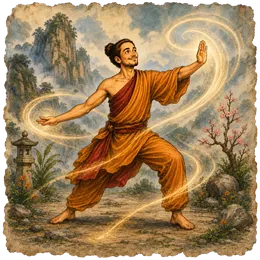 Sensations & Qigong4 sessions · 20 to 25 min · intermediate
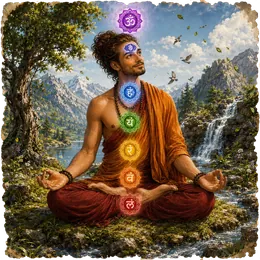 Body, Calm & Sleep14 sessions · 13 to 30 min · intermediate
Sessions to try first
- Warming the Hands20 min · intermediate · Sensations & QigongAn imaginary ball between the palms, a gentle warmth: the hands learn to feel before producing anything.
- The Small Circulation22 min · intermediate · Sensations & QigongFollow the path of the small circulation: a pearl descending from the belly, rising along the back, and closing the loop.
- The Still Tree23 min · intermediate · Sensations & QigongStanding still like a tree, arms around an imaginary ball: holding without forcing, rooted.
- The Dance of Qi — Qigong in Motion25 min · intermediate · Sensations & QigongQigong in motion: feet, hands and torso answering one another, slowly, until the body dances on its own.
- Breathing with the Whole Body13 min · intermediate · Body, Calm & SleepFeel the breath spread far beyond the lungs, like the rings of a drop falling into a pool.
Tools in the app
- Timer
Hold a standing posture in silence for as long as you choose, with an interval bell to mark each stage.
- Timed Ambience
Practice your own movements to one real ambient sound, such as a forest or a flute, for 5 to 60 minutes.
- Meditation history
After a session, note warmth, tingling or calm in the Body sensations section.
- Zen Passport
Earn a stamp when you practice the Sensations & Qigong category.
Related immersive worlds
 Monastery at Sunrise
 The Zen Garden
 The Tree of Consciousness
Frequently asked questions
What is qigong?
Qigong is a Chinese practice that combines slow movement or still postures, regulated breathing and focused attention. Its name joins qi, breath or vital energy, and gong, work or skill. It grew out of ancient exercises called daoyin and took its modern name in 1950s China. Today it is practiced around the world for calm, balance and self-cultivation.
What is the difference between tai chi and qigong?
Tai chi is a martial art built on a long, choreographed sequence called a form, which takes months to learn. Qigong is broader and simpler: often a few movements repeated, or a posture held in stillness, with a strong focus on the breath. Many teachers consider tai chi a form of qigong. Beginners usually find qigong easier to start.
Is qigong good for beginners?
Yes. Qigong for beginners can be as simple as one movement repeated slowly with the breath. There is no complex choreography to memorize, and most exercises can be adapted to your range of motion, standing or seated. Start with a few minutes a day, move gently and stay within what feels comfortable.
How long should you practice qigong?
Ten to twenty minutes a day is a good rhythm for most people. Regularity matters more than length: a short daily practice usually feels richer than one long session a week. Many people like morning qigong, right after waking. The guided sessions in the app last 20 to 25 minutes, and the Timer suits shorter practice.
What is qi, or chi energy?
Chi, or qi, is the vital energy that Chinese tradition sees flowing through all living things. In the body, it is said to move along channels called meridians and to gather in centers called dantian. Science has not measured qi as a physical energy. In practice, many people experience it as warmth, tingling or a feeling of fullness during qigong.
What are the Eight Brocades?
The Eight Brocades, or Ba Duan Jin, is a classic qigong set of eight movements, attested since the Song dynasty. Its name compares each movement to a piece of fine silk brocade. It includes Two Hands Hold Up the Heavens and Drawing the Bow to Shoot the Hawk. It is short, gentle and one of the most practiced qigong sets in the world.
What is qigong meditation?
Qigong meditation is the still side of qigong. You sit or stand without moving, regulate your breath and guide your attention through the body, often to the lower belly or along an inner circuit. The Small Circulation, a 22-minute session in the app, follows this kind of path. It is calmer than moving qigong, but just as attentive.
Is chi gong the same as qigong?
Yes. Chi gong, chi kung, qi gong and qigong all name the same practice. The differences come from how Chinese is written in Latin letters. Pinyin gives qigong, the older Wade-Giles system gives chi kung, and chi gong mixes the two. Whatever the spelling, you will find the same slow movements, regulated breathing and calm attention.
What is a good daily qigong routine?
A simple daily qigong routine can take ten minutes. Rub your palms and feel the warmth between them. Raise your hands overhead six to eight times with the breath. Stand like a tree for one to three minutes, then rest your hands on your lower belly. Morning practice is traditional, but any regular time of day works.
Qigong on the blog
Articles on qigong movements, breathing and the art of practicing a little every day.
Coming soon
- Coming December 26, 2026Qi Meaning: Chi Energy and the Vital Breath, Explained
- Coming February 10, 2027Qigong Exercises for Beginners: A Simple 10-Minute Routine
Practice for free
Every session is in the MeditaDream app: free, no subscription, no ads, no account, and it works offline.
✦ Discover the app