
In short
Astral projection is the experience of feeling your awareness leave your physical body and perceive from outside it. Esoteric traditions say your awareness travels in a subtle double, the astral body. Researchers call it an out-of-body experience, or OBE. They study the sensation itself, without ruling on whether anything actually leaves.
Astral projection meaning: astral travel, OBE and the astral plane
The astral projection definition is simple: you feel that your awareness has left your body, and you perceive from somewhere outside it. People often describe seeing their body from above, or floating near the ceiling.
The word astral comes from the Latin for “of the stars.” It reflects an old idea: a subtle body made of finer, luminous matter. Around it, a whole vocabulary has grown. The meaning of an out-of-body experience is purely descriptive, while astral projection carries a spiritual view of the world.
- Astral projection
The deliberate attempt to leave the body in awareness, usually from deep relaxation, at the edge of sleep.
- Astral travel
Often used as a synonym, like astral journey or astral trip. It stresses the journey itself: moving through rooms, landscapes or other realms once you feel separated.
- Out-of-body experience
The neutral, scientific term, often shortened to OBE. It describes perceiving from outside your body, whatever the cause.
- Astral body
In esoteric traditions, the subtle double said to carry your awareness. Many authors describe a silver cord linking it to the physical body.
- Astral plane
Also called the astral realm or astral world: the dimension this double is said to travel through, often described as fluid and shaped by thought. Theosophy made it one of seven planes, or levels, of existence.
Where the idea of astral travel comes from
The idea that part of us can travel without the body is very old. Many cultures tell of a soul or a double that wanders during sleep or trance. Ancient Egypt, for example, described the ba, a part of the person able to leave the tomb and move about.
The modern vocabulary comes from Theosophy. The Theosophical Society, founded in New York in 1875 by Helena Blavatsky and Henry Steel Olcott, spread the terms astral body and astral plane. In its model, a person has several subtle bodies, and the astral one carries feelings and desires.
In the twentieth century, the American Robert Monroe brought the subject to a wide audience. His 1971 book, Journeys Out of the Body, describes his own experiences in plain language. It helped popularize the phrase out-of-body experience, and Monroe later founded the Monroe Institute in Virginia.
Is astral projection real? Out-of-body experience and science
Out-of-body experiences are real experiences, whatever their cause. Many people report at least one in their lifetime, often by surprise, at the edge of sleep or in deep relaxation.
In 2002, Olaf Blanke and his colleagues described a striking case in the journal Nature. Stimulating the right angular gyrus, a region of the brain, made one woman feel she was floating above her body. Later work linked OBEs to the way the brain combines vision, balance and body sensations.
Some researchers have also hidden targets in rooms to test what people perceive during an OBE, and the results remain debated. These findings show that the brain can create the feeling of being outside the body. Whether anything actually leaves is a matter of belief, not measurement.
The astral experience: what does astral projection feel like?
Reports vary from person to person, but some sensations come up again and again. Knowing them in advance makes them less surprising, and practitioners say that staying calm helps the experience last.
- Vibrations or a buzzing that spreads through the body, sometimes with a rushing sound.
- Heaviness, then sudden lightness, as if the body were sinking or floating.
- A sense of swaying, rolling or slipping sideways.
- Seeing the room with your eyes closed, often a little differently from how it really looks.
- The feeling of a double sitting up, rising or hovering near the ceiling.
- Waking up unable to move for a few seconds, sometimes with a strong sense of presence.
How to astral project: classic techniques for beginners
If you are wondering how to astral project, most methods share the same base: a deeply relaxed body and an awake mind. People usually practice lying down, at the edge of sleep, or after waking early in the morning. Here is the sequence that astral projection for beginners often follows.
- Relax deeply
Lie on your back and release your body area by area. Let it grow so still that you almost stop feeling it.
- Stay awake inside
Keep a quiet, alert attention, like a light left on in a dark house. Most attempts happen at this edge between sleep and waking.
- The rope
Imagine a rope hanging above you. Climb it hand over hand with imaginary arms, without moving your physical ones. Robert Bruce popularized this method in his book Astral Dynamics.
- The roll-out
Imagine rolling sideways out of your body, the way you would roll off a mattress, without moving a muscle. Monroe described this approach.
- The imaginary fall
Feel yourself sinking or falling gently backward, and let the sensation carry you toward separation.
- The target
Before you begin, choose a familiar place or object. Once relaxed, picture yourself there in vivid detail.
Astral projection vs lucid dreaming
The two experiences are close cousins, and some people move from one to the other in the same night. The difference lies mostly in how they begin and how they are explained. Astral dreaming is a name some people use for experiences that fall in between.
If dreams are your natural doorway, our guide to lucid dreaming explains the main techniques, from the dream journal to WBTB.
| Astral projection | Lucid dreaming | |
|---|---|---|
| How it starts | From waking, through deep relaxation at the edge of sleep | From inside a dream, when you realize you are dreaming |
| The setting | Often your own room, seen from outside your body | The dream world, which can be anything |
| Typical sensations | Vibrations, floating, separation | A sudden recognition: this is a dream |
| How it is explained | In esoteric traditions, a subtle body travels | Awareness during REM sleep |
| Research | Studied as out-of-body experiences | Recorded in sleep labs since 1975 |
The Akashic records and past lives
The Akashic records belong to the same esoteric family as the astral plane. Akasha is a Sanskrit word for space, or ether. In Theosophy, the records are a memory of everything that has ever happened, kept in this subtle space.
Rudolf Steiner, who left Theosophy to found Anthroposophy, wrote of an Akashic Chronicle. Today, many people picture an Akashic library, an archive without end. Some practitioners offer an Akashic reading, in which they say they consult the records for you. This is a belief, not something research can test.
The idea of past lives often comes up alongside the records. In Hinduism, Buddhism and Theosophy, beings are said to be reborn many times. Meditation can explore these ideas as inner images, without proving them.
In the app, Higher Knowledge & Beyond works with the image of the records. The Keeper of the Archives, 24 minutes, trains one skill above all: telling what the mind invents from what seems to arise on its own. Past Lives & Time, 18 minutes, in Trances & Techniques, travels up the stream of your family line instead.
Is astral projection dangerous?
Practiced as meditation, astral projection is deep relaxation combined with imagination. There is no evidence that anyone can get stuck outside the body, and you can always open your eyes. The real challenges are fear, frustration and lost sleep.
Astral projection and sleep paralysis often go together. During REM sleep, your muscles stay relaxed so that you do not act out your dreams. If you wake before this ends, you may be unable to move for a few seconds and sense a presence. It is frightening, but it passes.
- If you wake up unable to move, breathe slowly and wiggle a finger or a toe.
- Ground yourself afterward: feel your weight, touch the floor, drink a glass of water.
- Practice when you are well rested, not on nights when sleep is precious.
- On days when you feel fragile, choose a calming session from Body, Calm & Sleep instead.
Astral projection guided meditation: the path in the app
In MeditaDream, astral practice is a progression rather than a single trick. It lives in the Astral tab of the Trance & Astral Projection screen, under the heading Non-Ordinary States. The path has three stages.
Micro-Detachment comes first, with five short exercises such as The Ceiling Magnet and The Point Behind Your Head. Separation Techniques then gathers six exit methods, from floating toward the ceiling to the rope, the imaginary fall and the target.
Astral Plane Exercises adds five more, for what comes after separation: a target to verify, an encounter protocol, movement, vision and visualizing the double. Astral · Movement Techniques, 20 minutes, rehearses what practitioners call astral flying: walking, gliding, then changing place in an instant. All of these guided astral projection sessions are marked as advanced. Some unlock as you practice, with points earned by meditating. The Trances tab, right beside it, leads to shamanic trance and other inner journeys.
- Step 1Micro-Detachment
Five short exercises to feel the first signs of separation, such as a gentle pull toward the ceiling or a tiny shift of your outline.
- The Ceiling Magnet17 min
- The Tiny Shift19 min
- The Point Behind Your Head16 min
- The Slide16 min
- The Phantom Sit-up20 min
- Step 2Separation Techniques
Six exit methods: floating toward the ceiling, rising up, inner limbs, the rope, the imaginary fall and the target.
- Astral · Floating Toward the Ceiling33 min
- Astral · Rising Up30 min
- Astral · Inner Limbs28 min
- Astral · Rope Technique29 min
- Astral · Imaginary Fall41 min
- Astral · The Target39 min
- Step 3Astral Plane Exercises
Five exercises for what comes next: a target to verify, an encounter protocol, movement, vision and visualizing the double.
Three stages, from small inner shifts to exercises after separation. Some sessions unlock as you practice.
Astral projection in MeditaDream
Each astral session is a guided meditation: a voice guides you through deep relaxation, then through one precise exercise. Astral · Rope Technique lasts 29 minutes, and Astral · Imaginary Fall 41 minutes. For gentler first steps, The Tiny Shift trains you to move the outline of your body by a tiny distance, in imagination.
The sessions download once, then play offline. Like everything in MeditaDream, they are free, with no subscription, no ads and no account.
Categories
 Astral Projection11 sessions · 16 to 41 min · advanced
 Micro-Detachment5 sessions · 16 to 20 min · advanced
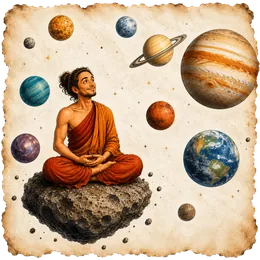 Cosmic & Void2 sessions · 28 to 31 min · advanced
Sessions to try first
- The Ceiling Magnet17 min · advanced · Micro-DetachmentFeel the body’s weight, and a gentle pull toward the ceiling.
- Astral · Floating Toward the Ceiling33 min · advanced · Astral ProjectionFeel the pressure of the surface fade until you have the sense of floating.
- Astral · Rope Technique29 min · advanced · Astral ProjectionClimb an imaginary rope to detach from the physical body
- Astral · Target to Verify19 min · advanced · Astral ProjectionNote what you perceive of a target before checking it, without correcting anything afterwards.
- Light Body Expansion31 min · advanced · Cosmic & VoidStart from the body’s warmth and let it become a light that reaches beyond the skin.
Tools in the app
- Trance & Astral Projection
Open the Astral tab to follow the three stages: Micro-Detachment, Separation Techniques and Astral Plane Exercises.
- The Oracle
Tap the Astral travel suggestion, or type how you feel, and receive three cards, each one a matching meditation.
- Spiritual Experiences
This Journal notebook keeps a private record of what you felt during each attempt, on your phone only.
- Meditation history
After a session, note your impressions in sections such as Body sensations and Images & symbols.
Related immersive worlds
 The Cosmic Temple
 Journey Through the Galaxy
 The Celestial Library
 The Mirror Dimension
Frequently asked questions
What is astral projection?
Astral projection is the experience of feeling your awareness leave your body and perceive from outside it. Esoteric traditions say a subtle astral body travels through an astral plane. Science studies the same experience under the name out-of-body experience, without ruling on whether anything leaves. People usually practice it lying down, in deep relaxation, at the edge of sleep.
What is an out-of-body experience?
An out-of-body experience, or OBE, is the feeling of perceiving the world from a point outside your physical body. People often describe floating near the ceiling and seeing their own body below. It can happen by surprise, at the edge of sleep or in deep relaxation. Researchers link it to the way the brain combines vision, balance and body sensations, without ruling on what it means.
How do I astral project for the first time?
Choose a time when you are well rested, such as early morning or a quiet afternoon. Lie on your back, relax your body completely and keep your mind gently alert. Then try one technique, such as the rope or the roll-out, for a few minutes, without forcing. Most first attempts end in calm rest or sleep. Note what you felt and try again another day.
Is astral projection dangerous?
Practiced as guided meditation, astral projection is deep relaxation combined with imagination. There is no evidence that anyone gets stuck outside the body. The main difficulties are fear, especially during sleep paralysis, and losing sleep through too many night attempts. Ground yourself after each session. If it weighs on you or keeps happening, ask a professional for advice.
What does astral projection feel like?
People often describe vibrations or buzzing, a sudden lightness, a sense of rolling or floating, and the feeling of looking at the room from above. Some see their own body. Others feel a double rising without seeing anything. The experience can be brief and dreamlike. Many practitioners say that staying calm is what lets it last a little longer.
What is the astral plane?
In Theosophy and later esoteric teachings, the astral plane, or astral realm, is a dimension of finer matter where the astral body is said to travel. It is often described as fluid, luminous and shaped by thought and feeling. This is a spiritual model, not a scientific finding. In meditation, you can explore it as an inner landscape.
What is the difference between astral projection and lucid dreaming?
Astral projection usually starts from waking: you relax deeply and feel yourself leave the body, often in your own room. A lucid dream starts inside a dream, when you realize you are dreaming. Sleep research has confirmed lucid dreaming. Astral projection is studied as an out-of-body experience, and its interpretation remains a matter of belief.
What did the CIA say about astral projection?
In 1983, a US Army report analyzed the Gateway Process, a set of techniques from the Monroe Institute. The CIA declassified the document in 2003, and it later became popular online. It offers a speculative theory of how the techniques might work. It is an analysis of a method, not proof that astral projection is real.
How long does it take to learn how to astral travel?
There is no fixed timeline. Some people have a spontaneous experience early, while others practice for months and mostly find deep relaxation. Short, regular sessions tend to work better than long, tense attempts. See the relaxation itself as the practice, and any feeling of separation as a bonus.
What are the Akashic records?
In Theosophy and later esoteric teachings, the Akashic records are a memory of everything that has ever happened. They are said to be kept in a subtle space called akasha, the Sanskrit word for ether. Many people picture them as a vast library. Their existence is a matter of belief, not measurement. In meditation, you can approach them as an inner image, as The Keeper of the Archives does in the app.
Can you access your Akashic records in meditation?
Many people try, through deep relaxation and an inner image such as a library or a keeper of archives. Whether the records exist cannot be proven. What meditation does offer is a calm space for memories, questions and intuitions. Stay discerning: note what comes, then ask whether it helps you live more clearly. The Keeper of the Archives, a 24-minute session, trains exactly this.
Astral projection on the blog
More on astral travel, out-of-body experiences and the exercises that prepare them.
Coming soon
- Coming December 7, 2026Altered states of consciousness, explained with examples
- Coming January 11, 2027How to astral project: a step-by-step progression
Practice for free
Every session is in the MeditaDream app: free, no subscription, no ads, no account, and it works offline.
✦ Discover the app