Bedtime Routine for Adults: How the 15 Minutes Before Bed Shape Your Night
A 15-minute bedtime routine for adults to wind down before bed: less stimulation, a brain dump, a mini body scan, and why it starts in the morning.
No, fifteen minutes don’t literally “decide” your night — but they can send your brain an extremely clear signal
Picture two scenarios: in the first, you wrap up a tense work exchange at 11:42 p.m., check the news, watch three videos, reply to a message, suddenly discover that an actor you’d forgotten about since 2009 has gotten divorced, naturally decide this information deserves an in-depth investigation, then put your phone down and demand that your brain switch instantly from “information, light, emotion, decision” mode to “deep sleep” mode; in the second scenario, the last fifteen to thirty minutes are predictable, dimly lit, calm and repetitive, and your body gradually receives a series of cues telling it the day is ending.
The second scenario obviously doesn’t guarantee eight hours of perfect sleep.
Sleep depends on many factors:
- homeostatic pressure;
- circadian rhythm;
- light;
- temperature;
- stress;
- physical activity;
- caffeine;
- alcohol;
- medication;
- health;
- environment.
So it would be scientifically absurd to claim that the fifteen minutes before bed determine your whole night, but they are an excellent behavioral window for creating a regular transition between activity and rest.
In fact, the real priority is broader than that quarter of an hour: a fairly regular wake-up time, appropriate exposure to light during the day and consistent habits often have more influence than a sophisticated ritual performed just before sleep.
In other words, the last fifteen minutes aren’t the sole conductor of your sleep.
They’re more like the end credits.
And good end credits help the brain understand that the movie is over.
Fifteen minutes before: turn down the stimulation rather than going to war on every screen
Screens have become sleep’s official villain, but the reality is more interesting than the slogan “blue light = insomnia,” because a smartphone can disrupt bedtime in several ways at once: light exposure, deliberately pushing back your sleep time, mental stimulation, emotions, notifications and the internet’s remarkable ability to turn “I’ll just look at one thing” into forty-seven extra minutes of content.
Evening light can affect the circadian system and melatonin secretion, especially when it’s bright enough and lasts long enough, but the response depends in particular on the intensity, spectrum, duration and timing of the exposure.
So the most reasonable strategy isn’t necessarily to panic because you checked the time on your phone at 10:51 p.m.
It’s to gradually reduce:
- brightness;
- emotionally stimulating content;
- work;
- notifications;
- endless scrolling.
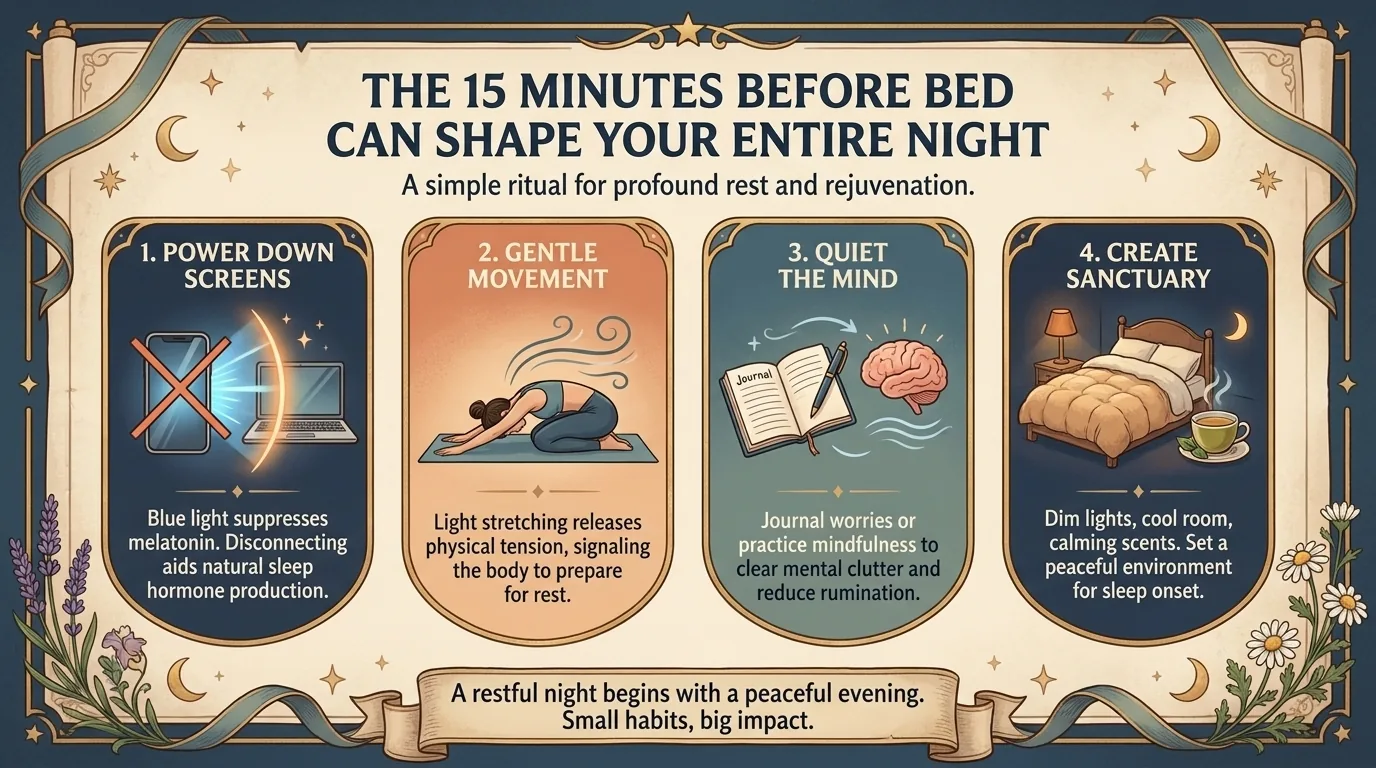
During the last fifteen minutes, ideally put your phone out of immediate reach, dim the lights and choose an activity that has a natural ending.
A few pages of a book have an ending.
Brushing your teeth has an ending.
Laying out your clothes has an ending.
A news feed doesn’t.
Your thumb could theoretically keep scrolling until retirement.
Ten minutes before: empty your brain of what it’s desperately trying not to forget

One of bedtime’s great enemies is the brain that suddenly remembers everything.
“I need to send that document.”
“Buy toothpaste.”
“Why did Julie answer like that?”
“Remember to call the garage.”
Rather than trying to hold on to all this mentally, do an extremely short brain dump: write down the tasks or worries that need action tomorrow, then close the notebook.
The goal is definitely not to start a full problem-solving session at 11:50 p.m.
Simply write:
“Garage — call at 10 a.m.”
“Report — finish introduction.”
“Julie — don’t decide anything tonight.”
That last category is particularly useful.
Not every nighttime thought deserves a nighttime solution.
You’re handing your external memory the job of holding on to the problem until the next day, which can reduce the subjective need to keep going over it in your head.
One frequently cited experimental study found that writing a to-do list before bed was associated with falling asleep faster than writing about tasks already completed, with an effect linked to how specific the list was; this single result obviously doesn’t turn the list into a universal sleeping pill, but it nicely illustrates the potential value of “offloading” future intentions onto paper.
Five minutes before: use your body as a context switch
You’re now in bed.
Rather than ordering:
“Sleep!”
which is roughly as effective as shouting “calm down!” at someone in the middle of a panic, simply give your body a monotonous, non-performance task.
Start by feeling the points of contact with the mattress.
Heels.
Calves.
Pelvis.
Back.
Arms.
Head.
Then let your exhale become slightly longer and comfortable, without hyperventilating, obsessive counting or turning it into a breathing competition.
Next, do a mini body scan: forehead, jaw, shoulders, hands, belly, legs.
You’re not trying to achieve perfect relaxation.
You simply observe:
“clenched jaw.”
Then you deliberately ease the tension by a few percent.
This nuance is crucial.
If your goal becomes:
“I absolutely have to be relaxed to sleep,”
relaxation itself can turn into yet another performance to pull off.
And insomnia feeds very easily on this kind of monitoring:
“Am I falling asleep yet?”
“Am I calm enough?”
“How many hours do I have left?”
Sleep is precisely one of those things we can encourage but can hardly command directly.
The ideal routine actually starts in the morning: light, regularity and sleep pressure

No evening ritual can fully make up for a day that sends mixed signals to your body clock.
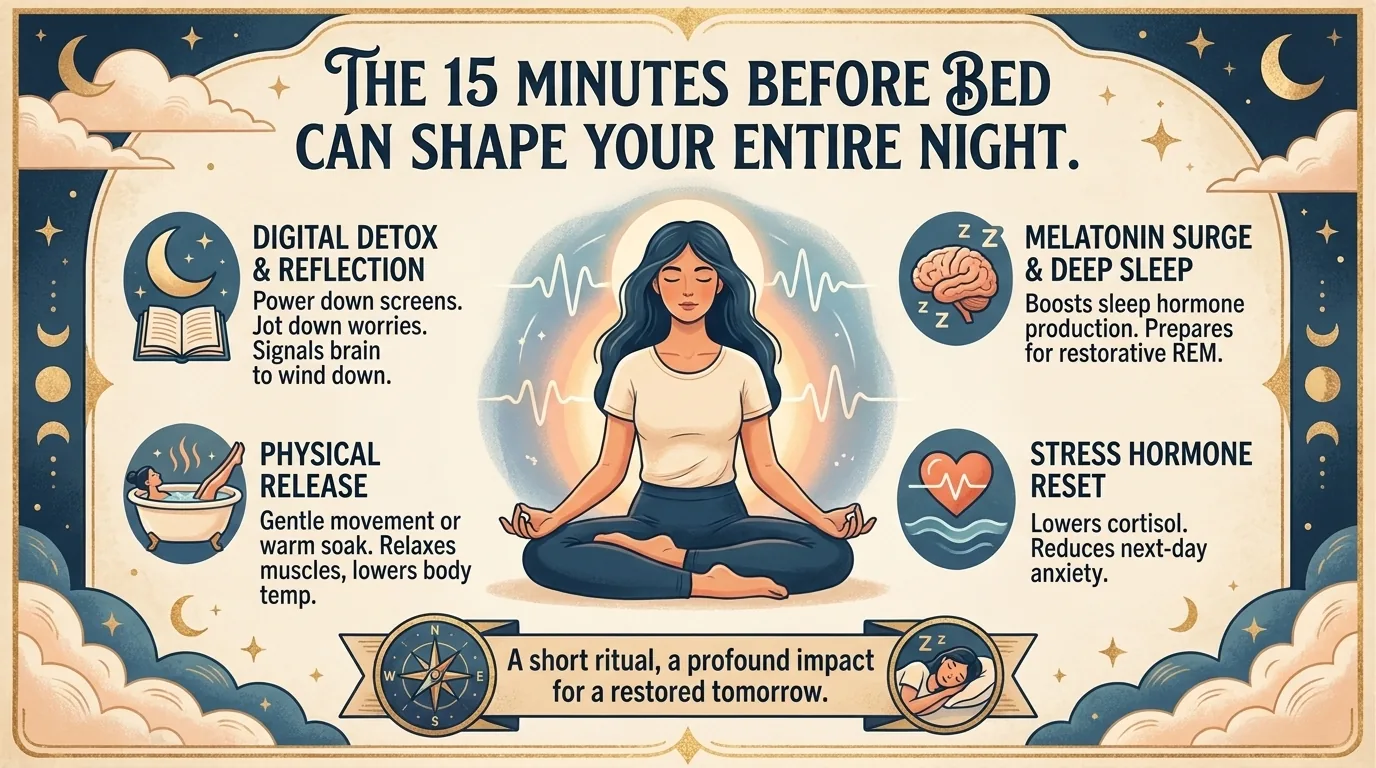
Exposure to natural light in the morning and during the day, physical activity, regular schedules and limiting bright light late in the evening all help with circadian synchronization, while sleep pressure builds gradually the longer you stay awake.
That’s why staying in bed until noon after a bad night and then trying to fall asleep at 10 p.m. can sometimes get complicated: you’ve changed both the rhythm and the accumulated pressure.
Temperature also plays a role, because falling asleep goes hand in hand with thermoregulatory changes, and an overly warm bedroom can disrupt sleep for some people; there’s no need to turn your bedroom into an industrial walk-in freezer, though, the goal is simply a comfortable environment, generally on the cool side rather than overheated.
Caffeine and alcohol also deserve their reputation, but for different reasons: caffeine can stay active for several hours and delay or disrupt sleep in some people, while alcohol may subjectively make it easier to fall asleep but then degrade the architecture and continuity of sleep.
So the best evening ritual is the one that ends a sleep-friendly day, not the one that heroically tries to repair in fifteen minutes everything the previous sixteen hours have sabotaged.
The complete fifteen-minute ritual — and what to do when sleep becomes a battle
Here’s a deliberately simple version.
15 to 10 minutes before: dim the lights, finish with stimulating screens, get your environment ready.
10 to 7 minutes: write down tomorrow’s tasks and worries.
7 to 3 minutes: bathroom routine, a few pages of calm reading or a repetitive activity.
3 to 0 minutes: in bed, feel the points of support, gradually relax a few areas of your body and let your breathing settle without trying to bring on sleep.
Then stop monitoring.
That may be the hardest part.
If you occasionally have a bad night, avoid catastrophizing: human sleep naturally varies to some extent.
However, when insomnia becomes chronic, the solution isn’t necessarily to keep adding more herbal teas, podcasts, pillow sprays, eye masks, supplements and rituals until your bedtime looks like the run-up to a space launch; cognitive behavioral therapy for insomnia (CBT-I) is considered a first-line treatment for chronic insomnia and works in particular on behaviors, beliefs and the association between bed and wakefulness.
A good ritual prepares you for sleep.
It should never become a superstition that says you won’t be able to sleep if you forgot step number four.
Frequently asked questions
How long before bed should you stop using screens?
There’s no magic cutoff that’s the same for everyone; reducing light and stimulation before bed is sensible, but the content you’re viewing, how long you use the device, its brightness and how much it delays your bedtime also matter.
What is the best evening routine for sleep?
A simple, repeatable routine that combines less stimulation, softer lighting, getting tomorrow’s tasks out of your head and a calm activity is generally better than a very complex ritual you can’t keep up.
Does meditation help you sleep?
It can help some people become less reactive to thoughts and stress, but it doesn’t replace established treatments for chronic insomnia.
What should I do if I can’t sleep despite good sleep hygiene?
Persistent insomnia deserves an assessment, in particular to look for medical or psychological factors and consider CBT-I, rather than endlessly piling up sleep tips.
Practice with the app
Rather practice than read?
Everything in this article can be practiced in MeditaDream, a free meditation app: 129 guided meditations and 17 immersive worlds, with no subscription, no ads, no account, and fully offline.
✦ Discover the free app