Best Time to Meditate: How Morning or Evening Affects Your Practice
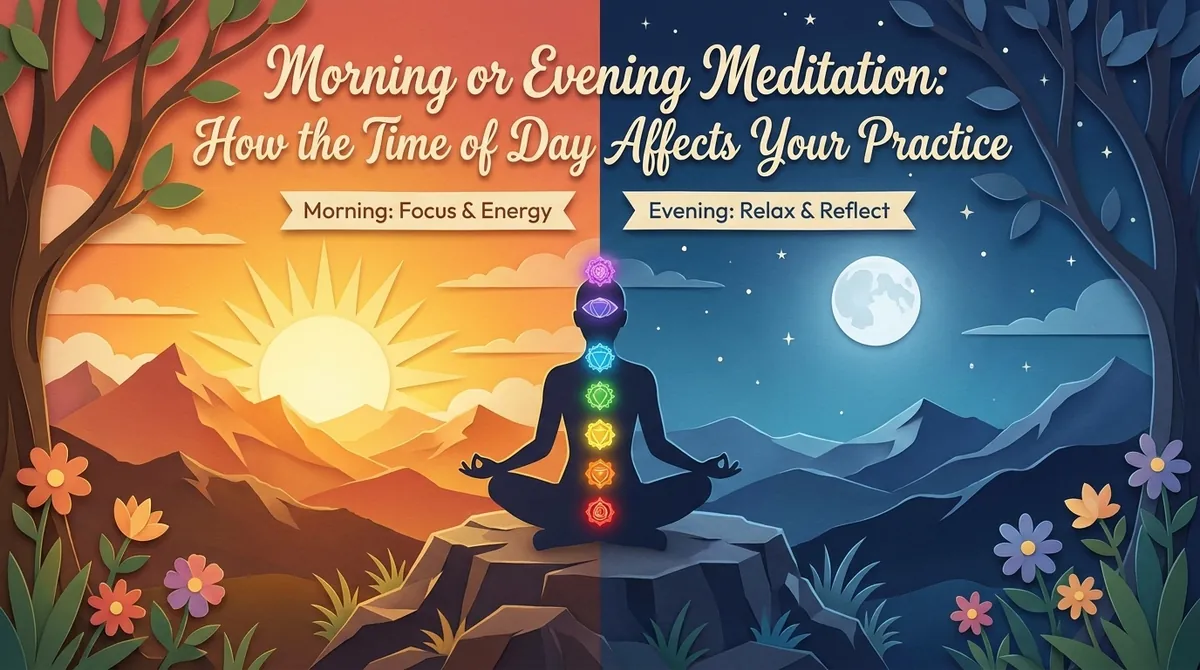
What is the best time to meditate, morning or evening? How cortisol, chronotype and habit shape it, plus simple routines for both ends of your day.
Morning or Evening? Both Answers Can Be Right
Search for “best time to meditate” online and you will quickly discover a surprisingly serious rivalry between 6 a.m. and 10 p.m.
Let’s reassure everyone:
The Buddha never issued a decree mandating 6:17 a.m.
The best time to meditate depends on your goal, your lifestyle and, above all, how likely you are to actually repeat the practice.
Mornings have certain advantages.
Evenings have others.
And a fifteen-minute session done regularly at an “imperfect” time will almost always be more useful than a theoretically optimal session you never do.
Morning Meditation: Training the Mind Before the World Arrives
When you wake up, your day hasn’t fully started yet.
No twenty emails yet.
No eight conversations yet.
Not yet that mysterious person who writes “urgent” about something that could clearly have waited until next Thursday.
That is one of the great advantages of morning meditation.
It comes before the demands start piling up.
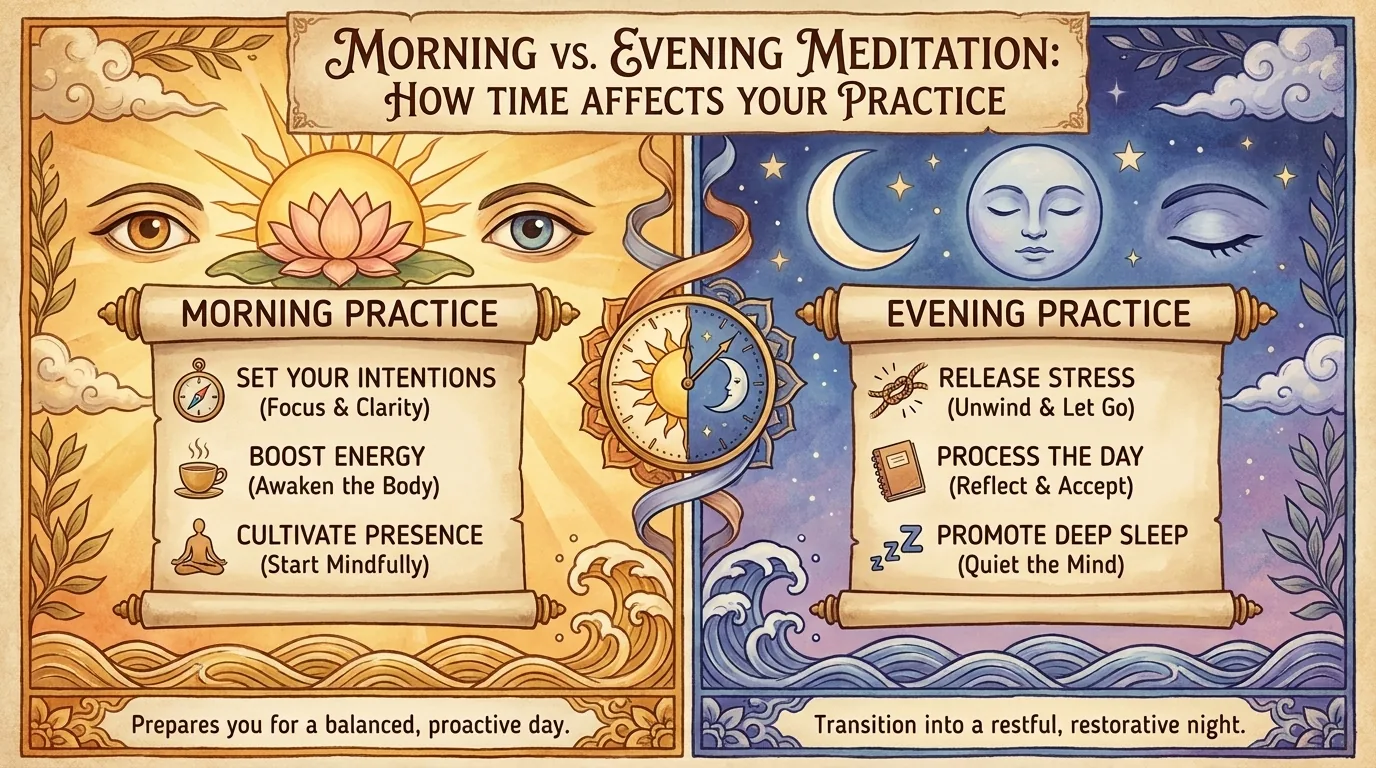
Circadian physiology is also different in the morning. The body naturally experiences a rise in cortisol around waking — the cortisol awakening response — which helps get the body going.
Meditating at that moment doesn’t mean you need to “suppress cortisol.” Cortisol is not some cartoon villain hormone.
It is necessary.
Morning meditation is more about starting the day with deliberate attention before autopilot kicks in.
It is especially useful for:
- concentration;
- setting an intention for the day;
- emotional stability;
- building a habit.
Evening Meditation: Unloading the Day

Evening meditation addresses a different problem.
Your brain often arrives in bed with 38 tabs open.
That morning conversation.
Work.
A project.
A bill.
Tomorrow.
That strange thing your coworker said at 2:12 p.m.
A breathing practice, a body scan or a mindfulness session can create a buffer zone between your active day and sleep.
In one study, a five-minute body scan done every evening for ten days helped reduce stress and repetitive negative thinking among participants. (PubMed)
Other trials of app-based meditation interventions have observed improvements in certain sleep-related symptoms among participants with sleep disturbances. (PubMed)
That doesn’t mean meditation is a universal sleeping pill.
But it can help when the problem stems partly from a mind that won’t switch off.
Pay Attention to Your Chronotype
Some night owls are at their sharpest at 11 p.m.
And some people’s cognitive abilities at 9 p.m. vaguely resemble those of a boiled potato.
Your chronotype matters.
If you are naturally a morning person, meditating as soon as you wake up can become an extremely stable habit.
If mornings are a battle involving three alarms, two coffees and diplomatic negotiations with your duvet, that may not be the ideal place to install a new discipline.
For evening types, meditating after work or before bed may be far more realistic.
The trap is choosing the schedule of an imaginary, perfectly organized person.
Choose the schedule of the person you actually are.
Morning and Evening Don’t Produce Quite the Same Session

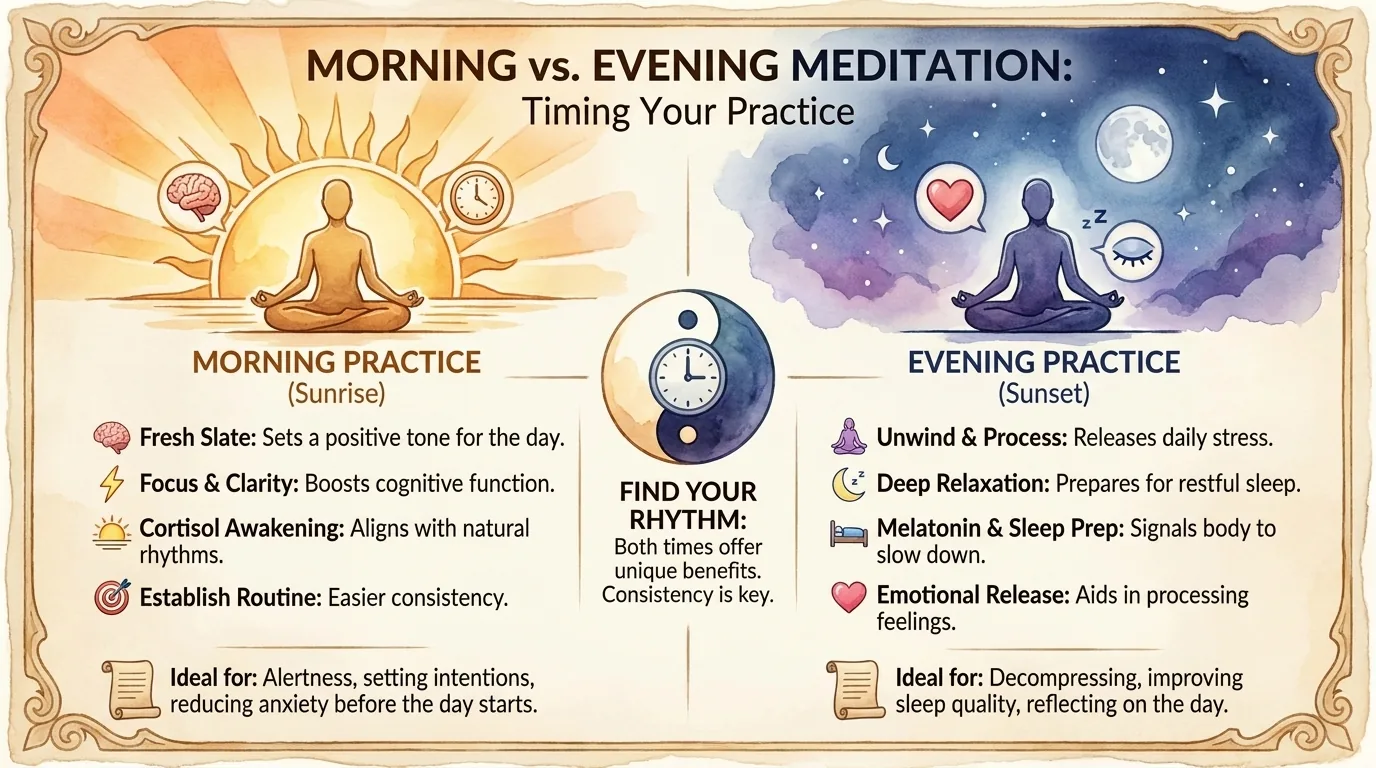
A morning meditation might aim for:
- alertness;
- attention;
- clarity;
- intention;
- observing the breath.
An evening meditation might favor:
- muscle relaxation;
- the body scan;
- slow exhalation;
- accepting that the day is over;
- reducing rumination.
So you can adapt the practice to the time of day.
In the morning:
- 10 minutes seated;
- back fairly straight;
- natural breathing;
- clear attention;
- end with a simple intention.
In the evening:
- 10 to 20 minutes;
- a more comfortable position;
- body scan;
- slow breathing;
- gradual letting go.
And what if you fall asleep during a meditation specifically designed for sleep?
Congratulations.
For once, missing the ending is probably the whole point.
The Real Rule: Choose the Time You Can Defend
Habit formation relies heavily on a stable context.
After your coffee.
After your shower.
After dropping the kids off.
Before shutting down your computer.
After brushing your teeth.
Meditation then becomes attached to an event that is already part of your day.
That is more powerful than:
“I’ll meditate sometime between 7 a.m. and midnight, whenever the universe tells me to.”
Try mornings for a week.
Evenings for a week.
Then compare:
When did I skip the fewest sessions?
When am I most present?
When does the practice have the best effect on the rest of my day or on my sleep?
You’ll have your answer.
Not a universal one.
But probably a better one.
Frequently asked questions
Is it better to meditate on an empty stomach in the morning?
It isn’t necessary. Some people enjoy the feeling of lightness before breakfast, but there is no general rule requiring it.
Can you meditate right before going to sleep?
Yes. Relaxation, breathing and body scan meditations are particularly well suited to that moment.
Could meditating in the evening keep me from sleeping?
A calm practice generally encourages relaxation, but some very stimulating or introspective meditations can increase alertness in certain people.
Can I meditate both morning and evening?
Yes. A short session in the morning and another in the evening make an excellent routine, as long as it stays easy to maintain.
Practice with the app
Rather practice than read?
Everything in this article can be practiced in MeditaDream, a free meditation app: 129 guided meditations and 17 immersive worlds, with no subscription, no ads, no account, and fully offline.
✦ Discover the free app