Crying During Meditation: Bug or Feature?
Crying during meditation? Why tears come, why it isn’t always “releasing trauma,” what to do in the moment and when to stop and return to grounding.
Why do I cry when I meditate?
Usually because the quiet of meditation lets you notice a feeling you were already carrying. It’s a common scenario.
You sit down to meditate.
Everything goes normally.
Breathing.
Body.
Silence.
Then, without anything dramatic happening:
your eyes start to sting.
Your throat tightens.
And the tears come.
First reaction:
“Why on earth am I crying?”
Second:
“Is something being released?”
Third:
“Is this normal?”
Yes, crying during meditation can happen.
And it doesn’t necessarily mean something is wrong.
But it’s best to avoid the automatic explanation that has become so popular:
“Your body is releasing stored trauma.”
That statement is far more confident than what science allows us to conclude.
A contemplative session can simply create unusual conditions:
- fewer distractions;
- more inward attention;
- greater body awareness;
- less immediate action.
An emotion that was already there can then become much more noticeable.
It isn’t necessarily an emotion that was “physically trapped” and has just left your tissues like steam.
Sometimes, you’ve simply noticed at last that you were sad.
And that already matters.
Why does silence bring up emotions during meditation?

Your normal day is extremely good at keeping certain experiences from reaching the foreground.
Alarm clock.
Phone.
Commute.
Work.
Messages.
Music.
Meeting.
Podcast.
TV series.
Sleep.
Then you suddenly decide to spend twenty minutes adding nothing.
A quiet emotion that was masked by mental noise can become much more obvious.
Picture a radio in a kitchen.
As long as three people are talking, you barely notice the music.
Everyone leaves the room.
The radio was already on.
You finally hear it.
A meditation can produce something similar.
Your attention turns toward:
- your breathing;
- tension;
- thoughts;
- images;
- memories.
A sensation in your chest suddenly becomes very clear.
Then an association appears.
Then tears.
Does crying during meditation always mean you’re sad?
No: tears are a much broader phenomenon than sadness.
We cry from:
- grief;
- relief;
- joy;
- exhaustion;
- frustration;
- tenderness;
- gratitude;
- a feeling of connection.
Some compassion or gratitude meditations can bring on tears precisely because they make certain emotional representations especially vivid.
Imagine a practice where you visualize someone you love.
You suddenly realize how much they matter to you.
The tears come.
That isn’t necessarily a symptom.
It’s an emotional response.
Likewise, after several extremely stressful weeks, finally lying down and hearing a voice say:
“You don’t have to solve anything for the next ten minutes”
can produce a powerful feeling of relief.
And sometimes relief cries.
Unfortunately, the human body refuses to provide a caption under every tear.
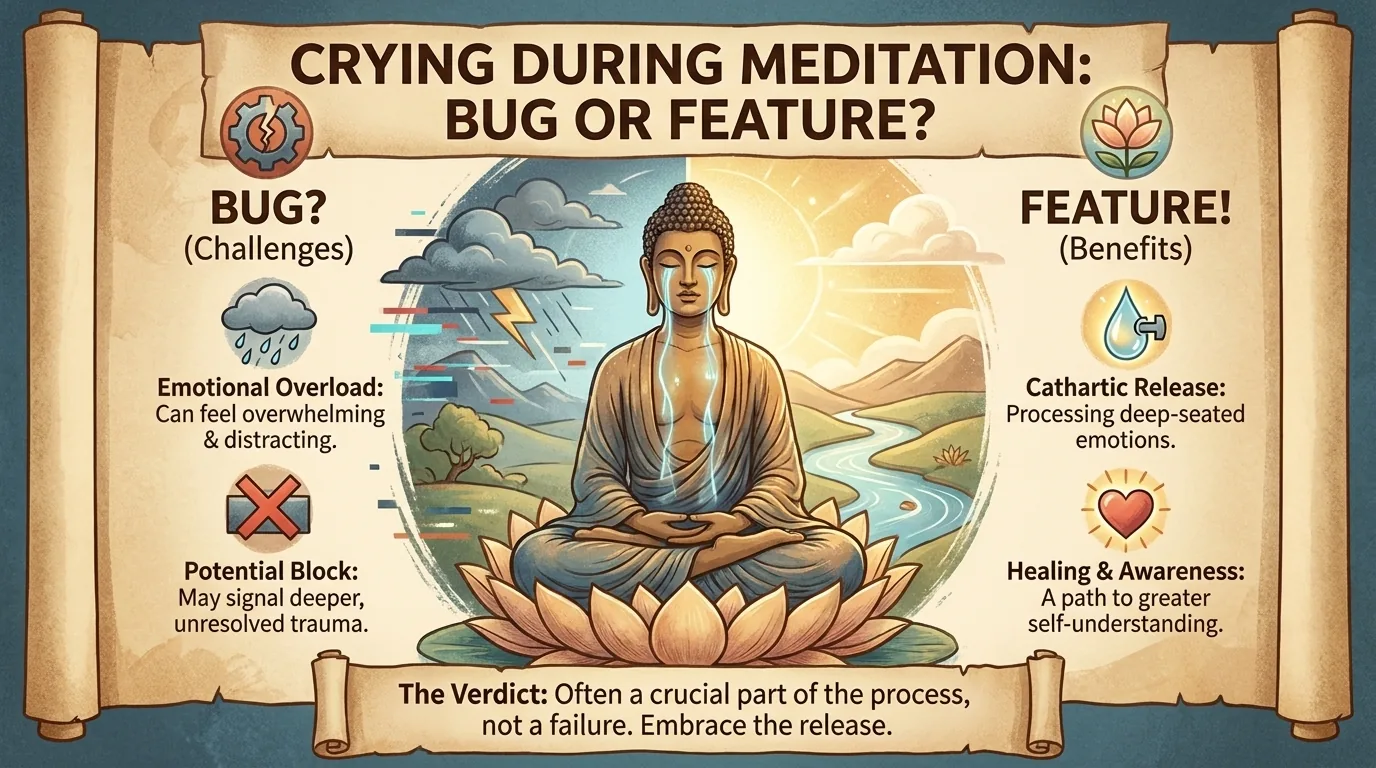
What should you do when you start crying during meditation?
The first rule:
don’t immediately turn the experience into a problem to solve.
You can simply note:
“sadness.”
Or:
“tears.”
Then feel what’s happening physically.
Tight throat.
Warmth behind the eyes.
Heavy chest.
Uneven breathing.
Try not to come up with a theory right away:
“It must be my great-grandfather’s intergenerational trauma.”
Stay with the information you actually have first.
Then you can gently ask yourself:
“Does this emotion seem to need something?”
Maybe:
- rest;
- crying for a few minutes;
- writing;
- talking to someone;
- making a decision;
- setting a boundary.
If you feel steady, let the emotion follow its natural course.
It may rise.
Hold.
Then fade.
Mindfulness is precisely about observing this movement rather than assuming an emotion stays frozen forever.
Is every intense reaction during meditation an emotional release?
No, even though some wellness talk presents every intense reaction as proof that the practice is working.
You’re shaking?
Release.
You’re panicking?
Release.
You’re completely thrown off balance for three days?
Major release.
That’s a bad rule.
Research on the unwanted effects of meditation shows that difficult experiences are not rare and that what they mean depends in particular on their intensity, duration and impact on daily life. Temporary reactions can be part of the meditative experience, but significant anxiety, reliving a traumatic event or persistent disturbances deserve a different kind of attention. (PubMed)
So the right question isn’t:
“Is it intense?”
But rather:
“Is it bearable, temporary and something I can integrate?”
Crying for ten minutes and then feeling steady:
one thing.
Having uncontrollable flashbacks and no longer sleeping:
quite another.
When should you stop meditating and ground yourself instead?
If the emotion becomes too intense, you’re under no obligation to stay still in the hope of winning a mindfulness medal.
Open your eyes.
Look around you.
Name five objects.
Feel your feet.
Place a hand on a stable surface.
Walk.
Talk to someone if you need to.
The goal is to get back enough contact with the present.
If you have lived through significant trauma, some meditations that focus very strongly on the body or on memories can sometimes be difficult. Recent research stresses the importance of adapting mindfulness practices to each person’s vulnerabilities rather than assuming one approach suits everyone. (PubMed)
And if your sessions regularly trigger:
- panic;
- feeling detached from yourself or your surroundings;
- flashbacks;
- severe confusion;
- lasting trouble sleeping;
- a significant drop in mood,
the right strategy isn’t necessarily to practice more.
It may be better to shorten, adjust or pause the practice and talk it over with a qualified professional.
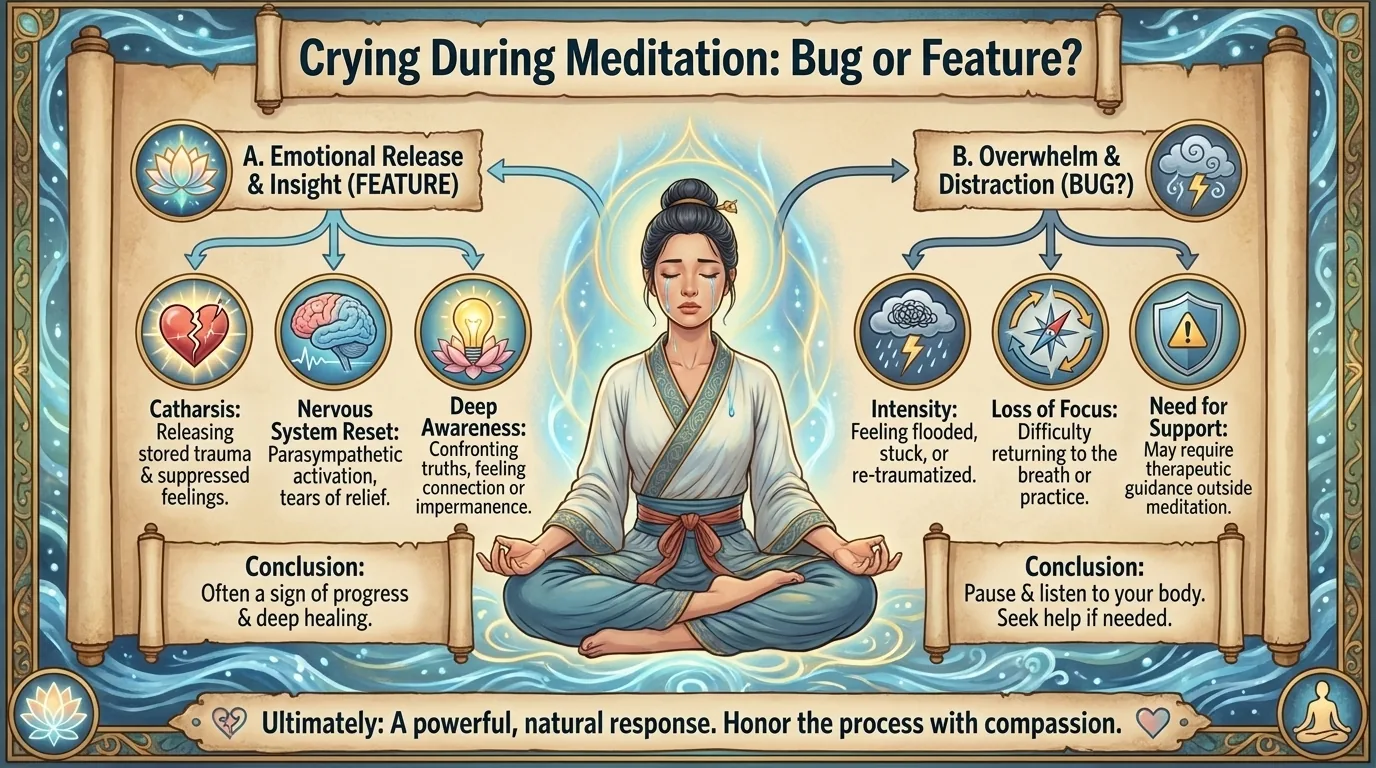
How do you handle a strong emotion during meditation, step by step?

When you feel the tears coming:
1. Name it
“sadness.”
“relief.”
Or simply:
“strong emotion.”
2. Locate it
Where do you feel it most?
Chest?
Throat?
Face?
Belly?
3. Allow it
“I can let this sensation be here for a few moments.”
4. Check in
“Is this still bearable?”
If so:
stay for a few breaths.
If not:
come back to your surroundings.
5. End consciously
Look at the room.
Move.
Jot down a sentence, if you like.
This structure lets you welcome the emotion without romanticizing it.
You don’t fight the tears.
But you don’t automatically award them a PhD in psychoanalysis either.
Can crying during meditation be good for you?
It can be useful without being magical: you don’t need to prove that every tear “flushes out a stored emotion” to recognize the potential value of the experience.
Crying can go along with:
- an acknowledgment;
- a realization;
- grief;
- a moment of compassion;
- relief.
But what really matters is what comes next.
If you realize during a meditation:
“I’m much more exhausted than I was admitting,”
the useful next step might be:
- sleeping;
- lightening a load;
- asking for help.
Not just repeating the same meditation until you produce more tears.
An emotion is often information.
Not necessarily a spiritual mission.
So the best emotional meditation isn’t the one that makes you cry the most.
It’s the one that lets you feel enough to understand, then come back steady enough to live.
Frequently asked questions
Is it normal to cry during meditation?
Yes, it can happen and doesn’t necessarily mean something is wrong. Calm and inward attention can make certain emotions more visible.
Do tears mean I’m releasing trauma?
Not necessarily. That interpretation works as a metaphor, but tears alone don’t allow us to conclude that trauma “stored in the body” is being biologically released.
Should I keep meditating when I cry?
If you feel steady and the emotion stays bearable, you can gently continue. If you feel overwhelmed, open your eyes, move and come back to your surroundings.
When should you ask for help?
If meditation regularly triggers panic, feeling cut off from yourself, reliving a painful memory, sleepless nights or distress that disrupts your daily life, a qualified professional can help you adapt your practice.
Practice with the app
- Emotional growth
- Guided self-love and self-compassion meditation
- Meet your shadow gently, one guided session at a time
Rather practice than read?
Everything in this article can be practiced in MeditaDream, a free meditation app: 144 guided meditations and 17 immersive worlds, with no subscription, no ads, no account, and fully offline.