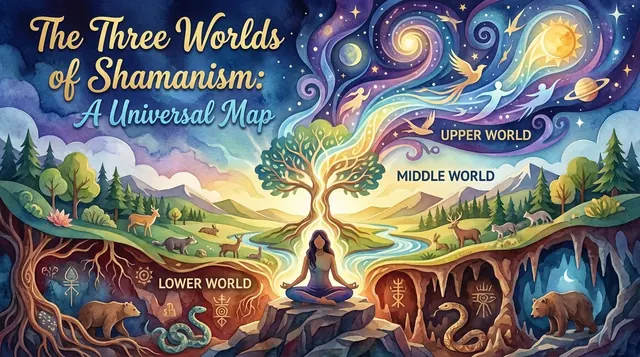
How to Find Your Spirit Animal: A Step-by-Step Journey
Looking for your spirit animal? On a shamanic journey, enter the Lower World, let your power animal appear, ask it questions and come back safely.
What is a power animal, really?
In contemporary shamanism, it’s an animal ally you meet during an inner journey, not just your favorite animal. Many people simply call it a spirit animal. Say you love wolves.
You’ve always found eagles magnificent.
So you wonder: “What is my power animal?”
And you decide: “Probably a wolf-eagle.”
Practice over.
Obviously, that is not how to find your spirit animal. The shamanic journey to meet a power animal is supposed to work differently.
In some forms of contemporary shamanism, especially those popularized by Michael Harner and core shamanism, the power animal is presented as an allied spirit met during a journey into non-ordinary reality, often in what this map calls the Lower World.
It can symbolize:
- protection;
- strength;
- a particular quality;
- a relationship with the natural world;
- guidance during the journey.
But one cultural clarification is essential.
The popular expression totem animal is often used as a synonym.
That’s not always appropriate.
The word “totem” comes from specific Indigenous traditions and can refer to family, clan, social or spiritual relationships far more complex than a simple “animal that matches me.”
That is the original totem animal meaning: kinship and belonging, not personality.
And not all Indigenous cultures share the same understanding of spirit animals.
Spirit animal vs power animal, then? In everyday speech, the two often overlap.
In this article, we’ll mainly talk about power animal shamanism as taught in contemporary Western methods, without claiming to describe a universal belief held by all Indigenous peoples.
Why go to the Lower World to find your power animal?

In the contemporary three-worlds model, the Lower World is often associated with nature, animals and instinctive forces.
You usually get there through an opening you imagine in the earth:
- a cave;
- a burrow;
- roots;
- a spring;
- a hollow tree trunk.
Why does this descent work so well in visualization?
Because it creates a very clear transition.
You don’t just close your eyes and wait for a bear to show up in your mental living room.
You make a journey.
Starting point.
Passage.
Descent.
Arrival.
This story-like structure makes absorption easier.
The brain understands:
“We’re now leaving the ordinary setting to enter another imaginary space.”
In a spiritual reading, this journey gives access to a non-ordinary reality.
In a psychological reading, it’s a deeply structured guided imagery exercise in which animals can emerge as spontaneous symbols.
You can practice with either interpretation.
Or leave the question open.
Step 1 — Choose an entrance you actually know
Before the session, think of a natural opening you’ve seen before.
A cave.
A hole between tree roots.
An opening under a rock.
An old hollow trunk.
Using a place you know gives your imagination a solid sensory foundation.
Sit or lie down.
Close your eyes.
Breathe normally.
Imagine the place.
Don’t rush.
Look, in your mind, at:
- the light;
- the texture;
- the ground;
- the colors.
Then move toward the opening.
If you’re using a drumming recording, choose a steady rhythm and a comfortable volume.
No need to crank it up to “Neolithic festival” level.
If you prefer a voice, record these steps as your own power animal guided meditation.
Step 2 — Go down without building every inch
Enter the passage.
At first, you’ll probably have to imagine things deliberately.
That’s normal.
Then gradually let the images evolve with less control.
The tunnel may:
- slope down;
- turn;
- widen;
- grow brighter;
- change texture.
Don’t try to work out:
“Is this my imagination or is it real?”
You’re in the middle of the exercise.
That question can come back later.
For now, just observe.
At the end of the passage, imagine an opening.
Step out.
What landscape appears?
Don’t look for the “correct shamanic” scenery.
If your Lower World looks more like a beach in Brittany than an Amazon rainforest, no cosmic committee is going to cancel your journey.
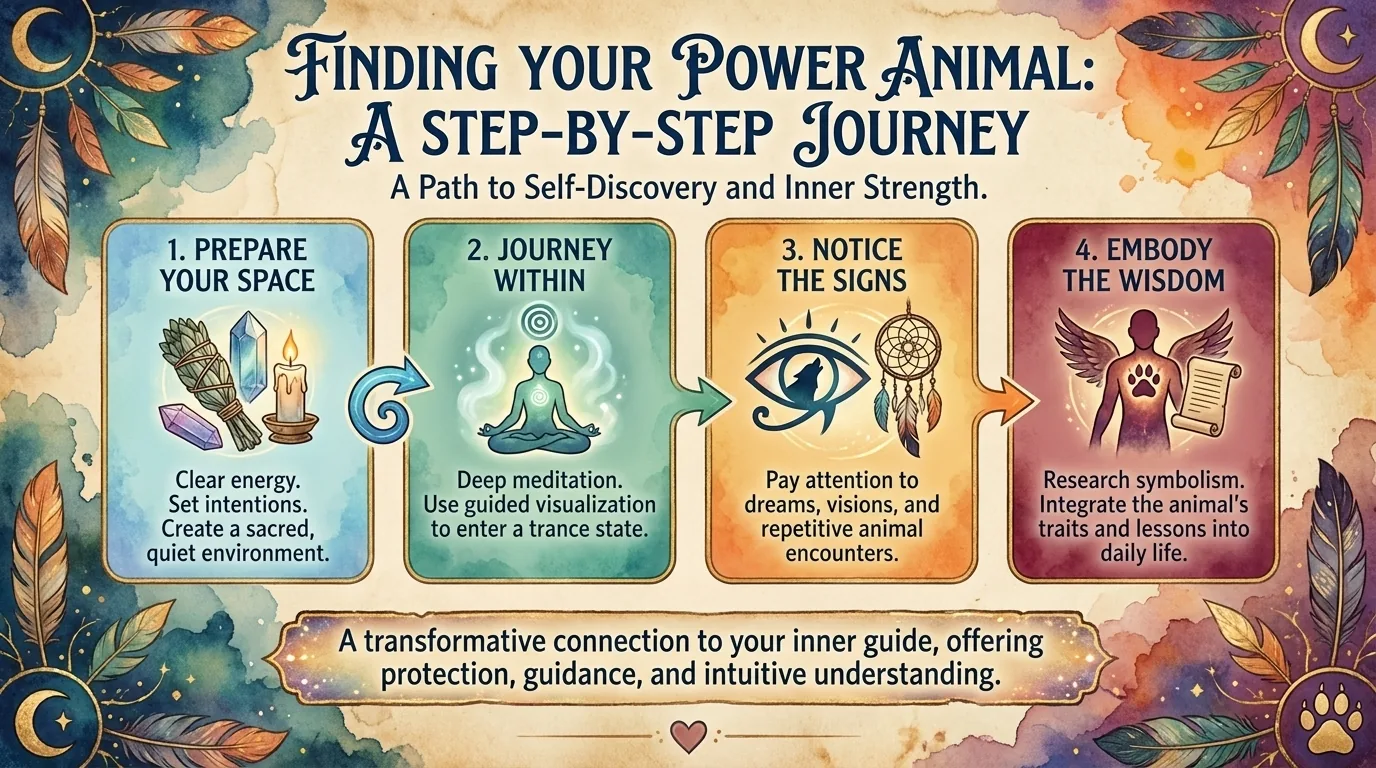
Step 3 — Let the animal appear instead of ordering a dragon
Start exploring.
Then ask, in your mind:
“Can an animal ally come forward?”
Wait.
Something may appear right away.
Or nothing.
An animal may pass by in the distance.
Another may come closer.
In some modern methods, the same animal appearing repeatedly is considered an important sign.
But don’t force it.
And above all, don’t immediately reject an animal because it lacks prestige.
Your imagination offers you a crow when you wanted a tiger?
Observe the crow.
A mouse?
Observe the mouse.
A goat?
Congratulations, you may have just met one of the most underrated animals in personal growth.
The whole point of a spontaneous symbol is that it doesn’t always match your ideal spiritual résumé.
Step 4 — Ask a simple question
Once the animal feels present enough, ask:
“Are you an ally for me in this practice?”
Then watch for the answer.
It may come as:
- a movement;
- an image;
- an inner word;
- a change in attitude;
- or nothing at all.
Then ask just one useful question:
“What quality can you help me develop right now?”
That’s far more interesting than:
“Give me the lottery numbers.”
Let’s say a deer appears.
It moves very slowly.
You might associate that with:
- alertness;
- gentleness;
- the ability to move forward quietly.
A wild boar might suggest:
- determination;
- protection;
- contact with the ground.
But steer clear of rigid dictionaries.
The most important question is:
“What does this animal represent for me?”
A snake can symbolize transformation for one person and fear for another.
Your personal history matters.
Step 5 — Come back properly
After a few minutes, thank the animal.
Head back to the entrance.
Find the tunnel.
Climb back up.
Return to your starting point.
Then feel:
- your hands;
- your legs;
- whatever is supporting your body.
Open your eyes when you’re ready.
Look around you.
This return phase is essential.
In deep visualization practice, knowing how to deliberately rebuild your ordinary bearings is part of the exercise.
A session isn’t better because you stay foggy for two hours.
The goal is exploration.
Not spending the afternoon in screensaver mode.
Is it normal to see nothing during a shamanic journey?
Yes. It’s even the number one beginner problem. You close your eyes.
Black.
You wait.
Still black.
Welcome to a much bigger club than you think.
Visualization abilities vary enormously.
Some people see extremely detailed images.
Others have faint imagery.
Some even describe aphantasia, meaning difficulty with, or an inability to, deliberately produce visual mental images.
That doesn’t rule out the inner journey.
Use:
- sounds;
- sensations;
- words;
- imagined movement;
- an intuitive sense of the scene.
You may not need to “see” a wolf.
You can simply have the feeling that a wolf is there.
An inner practice isn’t a 4K movie contest.
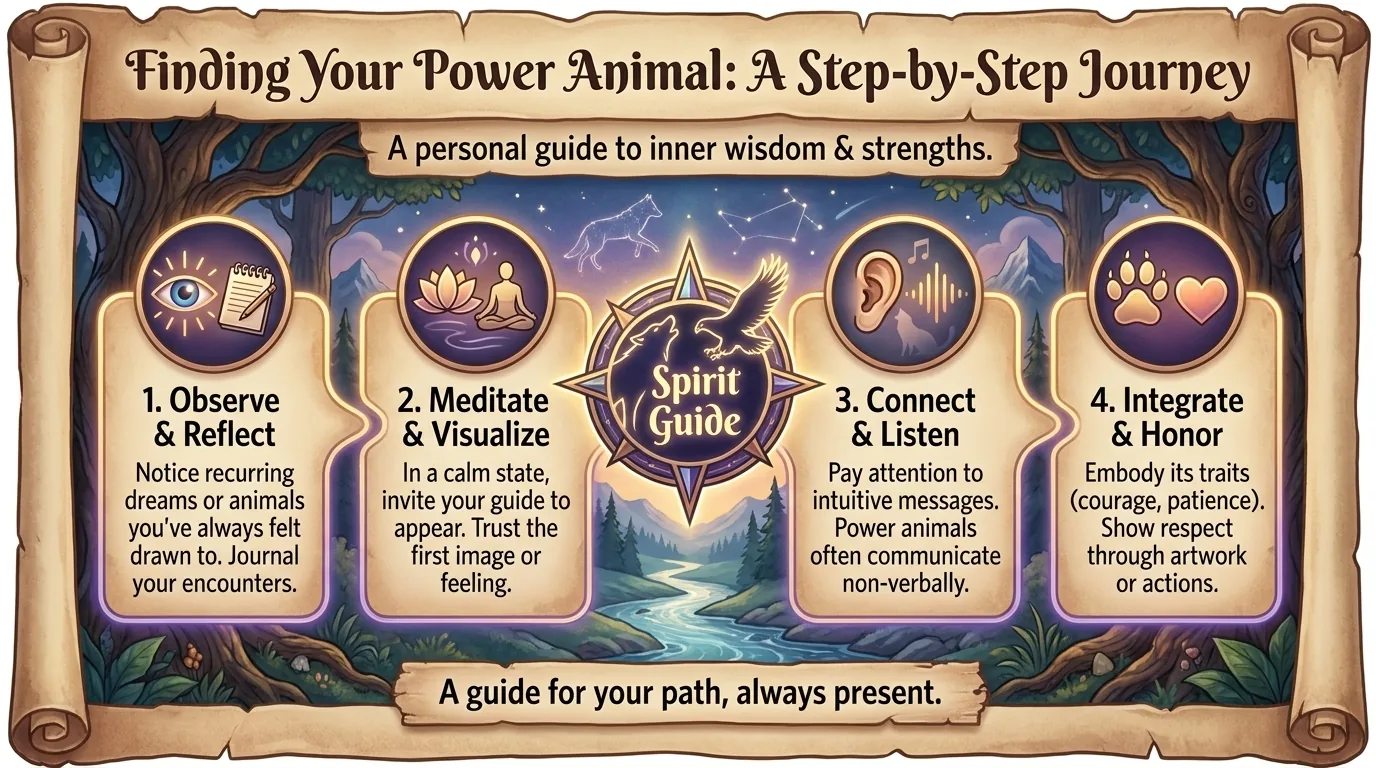
What if several animals appear?

Don’t rush to assemble your spiritual Pokémon team right away.
Just note down the animals.
Then watch for repetitions over several sessions.
A recurring symbol often becomes more interesting than a one-off appearance.
Keep a shamanic journey journal:
- date;
- animal;
- behavior;
- question;
- answer;
- emotion;
- events over the following days.
After ten power animal journeys, some patterns become visible.
Maybe the same animal comes back whenever you face a particular kind of decision.
Maybe your interpretation changes.
The journal also prevents rewriting history after the fact:
“My fox warned me about exactly this!”
Check what you actually wrote.
Intuition has a lot to gain from being checked against its own records.
How do you build a relationship with your power animal?
From a spiritual perspective, meeting an animal ally is only the beginning.
The relationship is built through repetition.
You can:
- go back to visit it in meditation;
- draw the animal;
- study how it actually behaves;
- observe its habitat;
- ask yourself what qualities it represents.
If your ally is a wolf, MeditaDream has a guided world built around the wolf spirit animal.
If your animal is the crow, actually learn something about corvids.
Intelligence.
Memory.
Social behavior.
Adaptability.
The animal’s real biology is often far more fascinating than any spirit animals list found online:
“Crow = transformation + mystery + message arriving at 2:32 p.m.”
A nature-based spirituality has everything to gain from knowing nature.
Is your spirit animal real or just your imagination?
Scientifically, we can’t establish that an animal met during a visualization is an autonomous external spirit.
Psychologically, however, we know that the imagination can produce characters, symbols and scenarios that feel surprisingly autonomous.
Spiritually, some people interpret these encounters as genuine relationships with non-ordinary beings.
You don’t have to settle this question during your first session.
Ask instead:
“What does this encounter actually change in the way I live?”
If your inner bear mostly teaches you to set better boundaries, the exercise already serves a purpose.
Even if the bear refuses to give you its mailing address.
Frequently asked questions
How do I know what my power animal is?
In some contemporary shamanic methods, you try to meet an animal spontaneously over repeated journeys rather than simply picking your favorite animal.
Are totem animals and power animals the same thing?
Not exactly. “Totem” belongs to specific Indigenous traditions and carries social and cultural meanings that go far beyond the modern idea of a personal animal guide.
What if no animal appears?
Keep going without forcing it, and use senses other than sight: sensation, sound, intuition or a word. Mental imagery abilities vary a great deal from person to person.
Can a frightening animal be a power animal?
In a symbolic practice, yes: an imposing animal can represent an important quality. If the experience becomes genuinely distressing, end the visualization, come back to your bodily sensations and only try again when you feel steady.
Practice with the app
- Shamanic trance
- Spirit guides
- Spirit guide meditation: guided journeys to meet your guides
- Guided shamanic meditation: the shamanic journey
Rather practice than read?
Everything in this article can be practiced in MeditaDream, a free meditation app: 144 guided meditations and 17 immersive worlds, with no subscription, no ads, no account, and fully offline.