Hypnosis vs Meditation: Differences, Similarities, and Which One to Choose
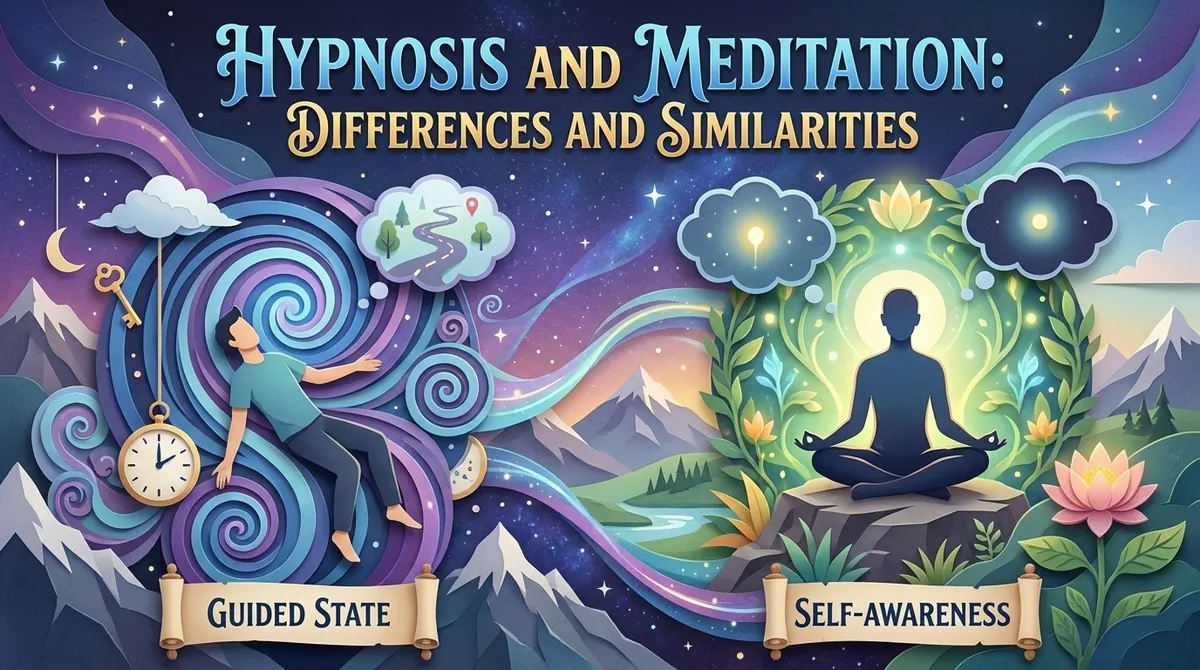
Hypnosis vs meditation: one changes an experience through suggestion, the other helps you observe it. Which one fits stress, pain or sleep?
What Is the Real Difference Between Hypnosis and Meditation?
In short, the hypnosis vs meditation difference comes down to this. Hypnosis uses suggestion to change an experience, while many forms of meditation train you to observe it. Picture the scene: you are lying down. A calm voice asks you to breathe slowly. Your muscles relax. Your attention becomes focused. You become less aware of the sounds around you. Then the voice continues. So, are you under hypnosis or doing a guided meditation?
At this point, there is no way to tell. That is because the two practices can look remarkably similar from the outside. The difference appears mainly in what we are trying to do with attention.
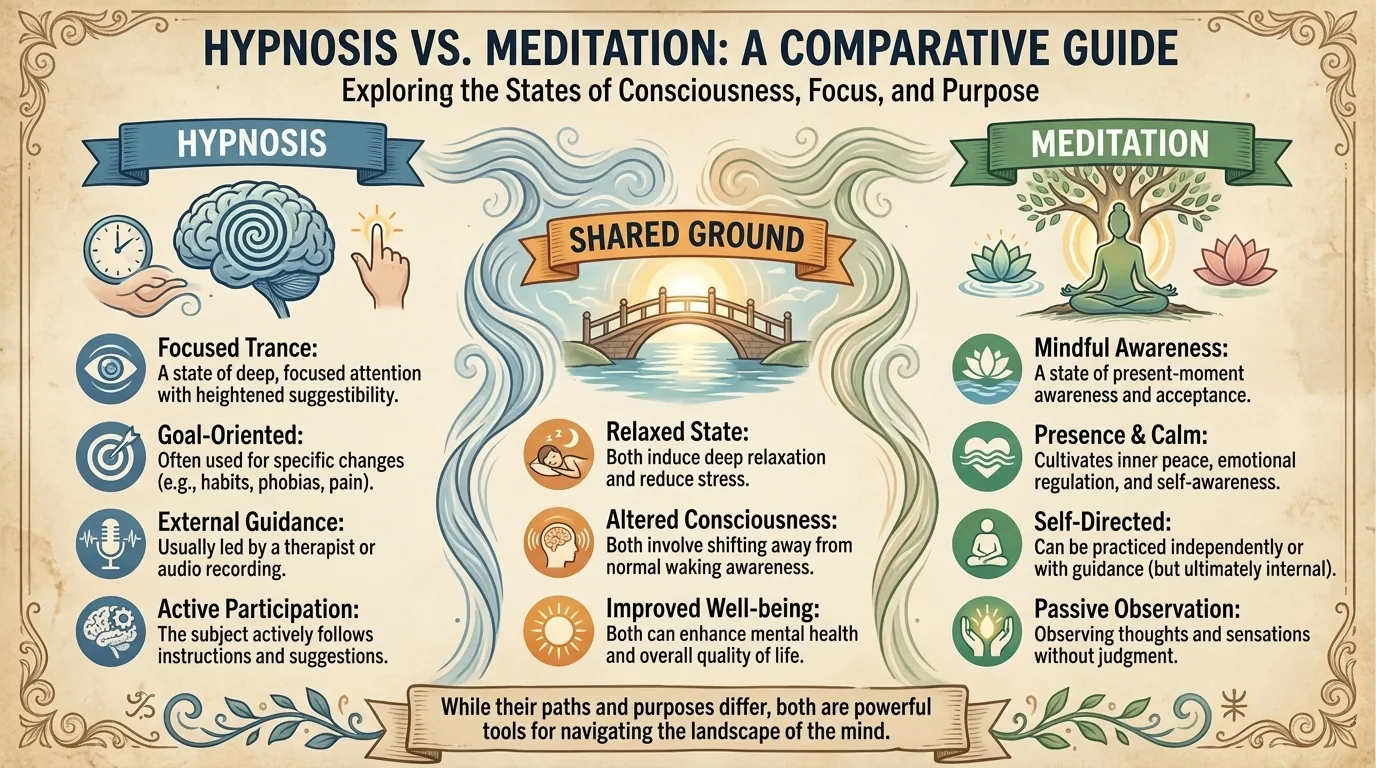
In hypnosis, focused attention is generally combined with suggestions intended to modify an experience: pain, a sensation, a behavior, a mental image, or a perception. In many forms of meditation, the aim is instead to develop observation, presence, attentional stability, or a different relationship with thoughts and sensations.
A scientific review devoted specifically to this comparison points out that meditation and hypnosis share certain phenomenological and neurophysiological features, while remaining distinct phenomena. It also notes that studies directly comparing the two are still relatively scarce.
In plain English: they may travel along neighboring roads. They are not necessarily going to the same destination.
How Does Hypnosis Work?

What is hypnosis? One widely used contemporary definition describes it as a state involving focused attention, reduced peripheral awareness, and an increased capacity to respond to suggestion. The key word is therefore: suggestion.
Is it an altered state of consciousness? Hypnosis researchers still debate that point. In hypnosis, state of consciousness and suggestion are hard to separate. What about trance vs hypnosis? Trance is a broad word for deeply absorbed states, found in many cultures. Hypnosis is a more specific practice, built on suggestion.
Imagine someone using hypnosis to reduce pain. The practitioner might suggest: “Imagine this area becoming cold.” Or: “The sensation is gradually changing shape.” The suggestion is intended to modify the person’s subjective experience.
The same principle applies to certain habits or behaviors. Hypnosis can use:
- mental imagery;
- metaphors;
- direct suggestions;
- time distortion;
- sensory modification.
Someone who is highly responsive may sometimes experience a suggestion with astonishing vividness. An arm may feel light. A sensation may decrease. A mental image may become extremely realistic. The brain does not become passive. Quite the opposite. It actively constructs the suggested experience.
How Does Mindfulness Meditation Work?
Mostly by noticing more instead of suggesting more. Consider a mindfulness meditation: an uncomfortable sensation appears in your knee. The instruction might be: “Observe the sensation exactly as it is.” Warmth? Pressure? Pulsation? Variation? Then observe the mental reaction: “I don’t like this.”
You learn to distinguish the sensation itself from the commentary about it. The difference is subtle but fundamental. In hypnosis, you might try to transform the experience. In mindfulness, you often try to observe how it works.
Of course, this contrast is not absolute. Some meditations make extensive use of visualization and repeated phrases. Some forms of hypnosis strongly develop observation and metacognition. That is precisely why the boundaries can sometimes feel blurry.
Do Hypnosis and Meditation Affect the Brain the Same Way?
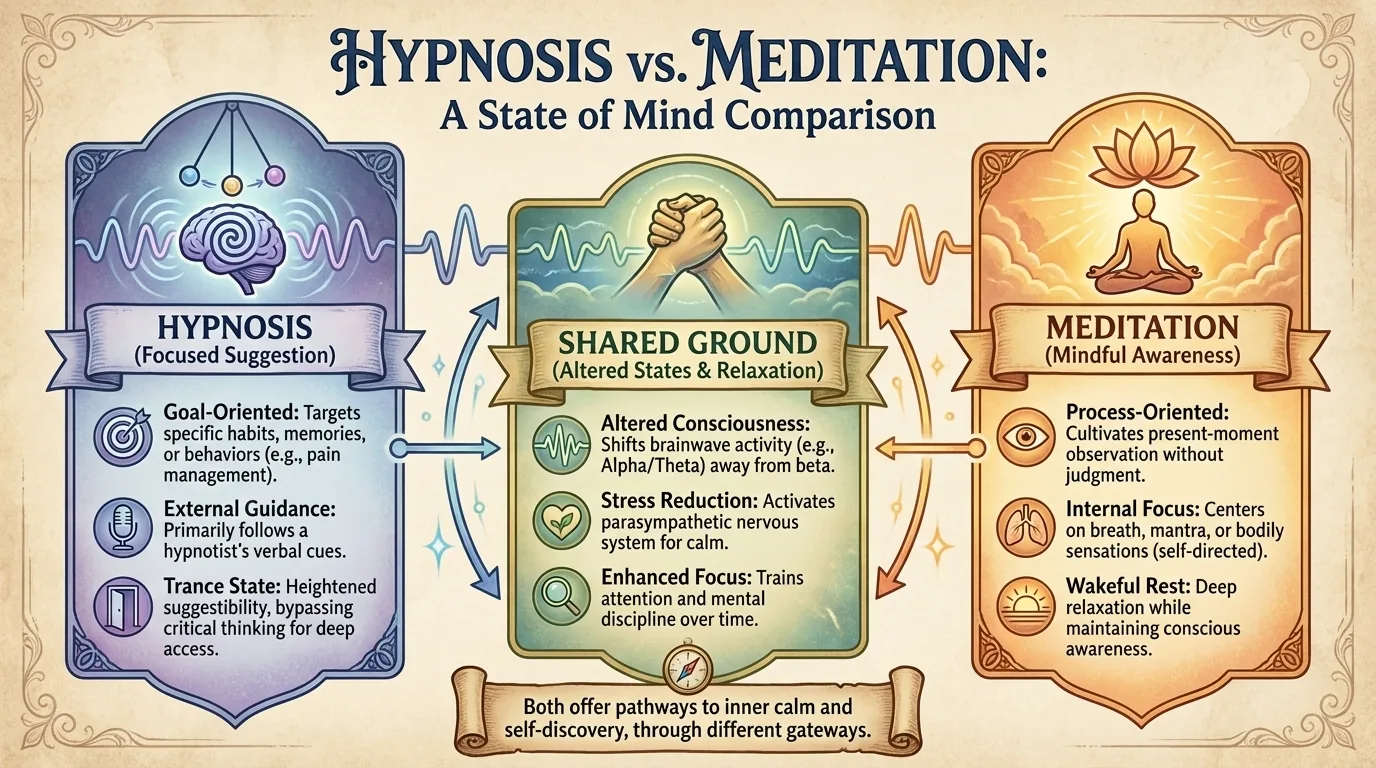
Similar, but not identical. Neuroimaging studies are particularly interesting because they reveal both common ground and differences. A scoping review drawing on 97 references — 84 focused on mindfulness and 13 on hypnosis — identified changes involving some similar networks, including interactions between executive, salience, and default-mode networks, while also observing practice-specific differences.
Most importantly, the authors emphasized the need for more rigorous studies and direct comparisons. That caution is essential. Saying “Hypnosis and meditation sometimes involve neighboring brain networks” does not mean “Hypnosis and meditation are exactly the same thing.”
Cycling and running both use your legs. That does not mean you are competing in the Tour de France while wearing running shoes.
A Side-by-Side Look at Hypnosis vs Meditation
| Criterion | Meditation | Hypnosis |
|---|---|---|
| Main goal | Observe, stabilize attention, develop presence or compassion depending on the practice | Modify an experience or behavior through suggestion |
| Role of suggestion | Variable; often secondary in mindfulness | Generally central |
| Guide required | No | No; self-hypnosis exists |
| Metacognition | Often explicitly trained | Varies |
| Mental imagery | Possible but not essential | Very common |
| Relaxation | Common but not essential | Common but not essential |
| Attention | Focused or open depending on the practice | Often strongly focused |
| Clinical use | Stress, anxiety, pain, relapse prevention depending on protocol | Pain, anxiety, medical procedures and other indications depending on protocol |
| Independent practice | Very common | Possible through self-hypnosis |
| Experience of “trance” | Possible but not necessary | Often used to describe the hypnotic state |
The table mainly shows one thing: choosing between hypnosis and meditation depends far more on your objective than on the question: “Which one is more powerful?”
The same goes for self-hypnosis vs meditation: both can be practiced alone, so your goal still decides.
When Is Meditation the Better Choice?
If your goal is to develop a healthier relationship with your thoughts, recognize rumination more quickly, or establish a daily self-regulation practice, mindfulness meditation is particularly well suited.
Why? Because it is designed as regular training. You learn to sit. Observe. Return. Then reuse that skill throughout the day. Meditation gradually becomes less of an isolated session and more of an ability to notice: “I’m disappearing into a mental scenario again.”
That transfer into everyday life is one of its greatest strengths.
When Can Hypnosis Be the Better Choice?

Now suppose your goal is highly specific:
- changing the perception of pain;
- reducing anxiety related to a procedure;
- working with a bodily sensation;
- preparing for a particular situation.
The targeted nature of clinical hypnosis and suggestion can become especially useful. Suggestion allows you to construct an alternative experience. A painful sensation may symbolically be transformed into:
- warmth;
- cold;
- distance;
- numbness;
- variation.
In this context, the aim is not simply to observe. It is to actively modify the experience. That is one of the major practical differences from classic mindfulness meditation.
Is Hypnosis or Meditation Better for Sleep?
Both can work as relaxation tools. An evening meditation can:
- slow your breathing;
- reduce rumination;
- bring attention toward the body.
Sleep hypnosis may add suggestions such as: “Your body is becoming heavier and heavier.” “You no longer need to follow my voice.” “Each thought can drift farther away.”
The two formats can therefore sound remarkably similar in an audio app. The main difference lies in the architecture of the script. Meditation often asks you to observe. Hypnosis is more likely to invite you to allow certain transformations to occur.
Can You Combine Hypnosis and Meditation?
Yes. And in contemporary practice, the boundary is sometimes already porous.
A guided meditation may use:
- metaphors;
- visualizations;
- repeated phrases;
- body imagery.
Modern hypnosis may include:
- attention to the breath;
- observation;
- body awareness;
- acceptance.
The scientific literature itself is interested in these overlapping areas. A neuroimaging review points out that mindfulness and hypnosis show certain similarities in brain networks involved in attention and regulation, without providing grounds for considering them identical.
So the two approaches can absolutely be combined. Provided you know what you are doing.
How Do You Choose Between Hypnosis and Meditation?
Simply ask yourself:
1. Do I want to observe or modify?
Observe → meditation. Modify → hypnosis may be worth exploring.
2. Do I want a general everyday skill?
Meditation is particularly well suited.
3. Do I have a very specific goal?
Hypnosis may become highly relevant.
4. Is this a serious health problem?
In that case, the most important question is not whether you choose an audio track labeled “hypnosis” or “meditation.” It is choosing a competent professional and an appropriate method.
So the right question is not: “Hypnosis or meditation: who wins?” They are not in a boxing ring. The real question is:
“What am I trying to train or change?”
Frequently asked questions
Is Meditation a Form of Hypnosis?
Not in the strict sense. They may share relaxation, focused attention, and absorption, but suggestion generally plays a much more central role in hypnosis. Direct scientific comparisons identify both overlaps and differences.
Does Hypnosis Make You Lose Control?
No. The image of someone being completely controlled by a hypnotist largely belongs to stage entertainment and popular mythology. Hypnotic responsiveness involves the participant’s cooperation and varies considerably from one person to another.
Can You Practice Self-Hypnosis?
Yes. Many self-hypnosis methods use relaxation, focused attention, visualization, and self-suggestion.
Which Practice Is Better for Stress?
For developing a general ability to manage stress and observe your thoughts, meditation is particularly well suited. For a more specific target, hypnosis may be useful. The two can also complement one another.
Practice with the app
- Shamanic trance
- Astral projection
- Waking dream meditation
- Deep trance journeys and gentle self hypnosis, step by step
Rather practice than read?
Everything in this article can be practiced in MeditaDream, a free meditation app: 144 guided meditations and 17 immersive worlds, with no subscription, no ads, no account, and fully offline.