Benefits of meditation: what the science really shows
The benefits of meditation science can actually measure: what regular practice changes in the brain, breath and attention, and what research does not say.
What actually happens in your brain and body when you meditate? Attention, stress, sleep: research has documented some benefits of meditation well — and others far less. An honest tour of what the science says, and what it doesn't.
What are the benefits of meditation, according to science?
What happens in your brain when you meditate?
With regular practice, three brain systems start to work differently. Thanks to neuroplasticity — the brain's ability to remodel itself through experience — meditation acts like targeted strength training: the prefrontal cortex (the attention conductor) gains efficiency, the amygdala (the threat detector that triggers stress) becomes less reactive, and the default mode network quiets down more easily. That last circuit switches on whenever you're “doing nothing” and produces rumination: the endless inner loop of worries and scenarios.
How does meditation calm your nervous system?
It moves your body out of alert mode and into rest mode. The autonomic nervous system has two pedals: the accelerator (sympathetic system — alert, fast heart, tense muscles) and the brake (parasympathetic system — digestion, repair, calm). Modern life keeps pressing the accelerator; meditation trains you to use the brake again.
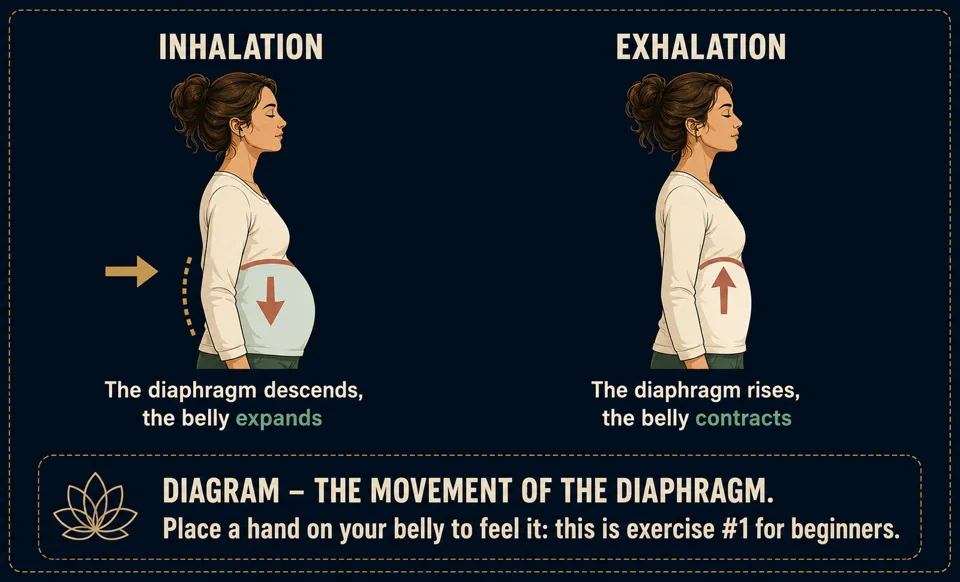
The main cable of this brake is the vagus nerve. It links the brain to the heart, lungs and belly — and it has a precious feature: long exhales stimulate it directly. That's why all the calming techniques in this library (4-6, 4-7-8, cardiac coherence, physiological sigh) lengthen the exhale: it's a mechanical, immediate access to physiological calm.
You can feel it right now. Breathe in through your nose for 4 counts, then out slowly for 6 counts, five or six times. Your heart speeds up slightly as you breathe in and slows down as you breathe out: each long exhale gives the brake more time to work.
⏱ Immediate
From one session: lower heart rate, muscle relaxation, clearer mind (vagal brake effect).
📅 A few weeks
By 8 weeks of daily practice: perceived stress down, measurably more stable attention, better sleep.
🗓 Long term
In regular practitioners: lasting changes seen in brain imaging, and calmer emotional reactions over time.


Does meditation actually work?
Yes. Among the benefits of meditation, science is most confident about stress, mild to moderate anxiety, attention and sleep. These effects hold up in controlled studies, where people who meditate are compared with similar people who don't. In the strongest studies, volunteers are split at random into two groups. One group meditates, often for eight weeks, the length of the MBSR program (Mindfulness-Based Stress Reduction). The other group waits its turn or does another activity, such as relaxation. Researchers measure both groups before and after.
To see what changes, they combine several tools: questionnaires on stress, mood and sleep, attention tests, heart rate and breathing measures, and brain imaging. MRI shows the brain's structure and activity; EEG records its electrical rhythms. Mindfulness programs like MBSR are the most studied; breathing practices, loving-kindness and mantra meditation have been studied too, but less.
Why are some meditation benefits still uncertain?
Because meditation is hard to study well. Many studies are small or short. There is no perfect placebo: you know when you're meditating, and simply expecting to feel better can help. People who have meditated for years may also have been different from others before they started, so comparing them doesn't prove that meditation caused the difference. And when meditation is compared with other healthy habits, such as exercise, it isn't always better. That's why claims about immunity or slower aging remain promising rather than proven.
Can meditation make you feel worse?
Sometimes, yes. A minority of people feel more anxious, restless or emotional when they meditate, especially during long or intense sessions such as silent retreats. It's often mild and temporary, but don't force your way through it. Shorten the session, open your eyes, and come back to simple anchors: your feet on the floor, the sounds in the room, a slow exhale. Walking meditation can also feel easier than sitting still. If the discomfort lasts or keeps coming back, talk to a health professional.
Frequently asked questions
How long before you feel the benefits of meditation?
The first sessions already relax the body; effects on attention and stress generally settle in after a few weeks of regular practice. Regularity matters more than duration.
How many minutes of meditation per day?
Ten minutes a day beats one hour on Sunday. Studies usually work with 10 to 20 daily minutes; start at five and increase when you feel like it.
Does meditation replace professional support?
No, never. It's a well-being practice that can complement professional support, not substitute for it. If you're going through something serious, talk to a professional.
Practice with the app
- Immersive worlds
- Free meditation for beginners, guided step by step
- Quick meditation for anxiety
- Buddhist Meditations
Rather practice than read?
Everything in this article can be practiced in MeditaDream, a free meditation app: 144 guided meditations and 17 immersive worlds, with no subscription, no ads, no account, and fully offline.