Third Eye Meaning: Myth, the Pineal Gland, and Intuition

Third eye meaning, from the Ajna chakra to what the pineal gland really does: why you feel pressure between your eyebrows, and an honest meditation.
What is the third eye meaning, really?
The third eye meaning fits in a few words: a symbol of inner perception. Few spiritual symbols have been as successful.
It shows up in discussions about chakras, intuition, meditation, clairvoyance, dreams, altered states of consciousness, the pineal gland, visualization, and sometimes far more adventurous theories that make science politely stare at its shoes.
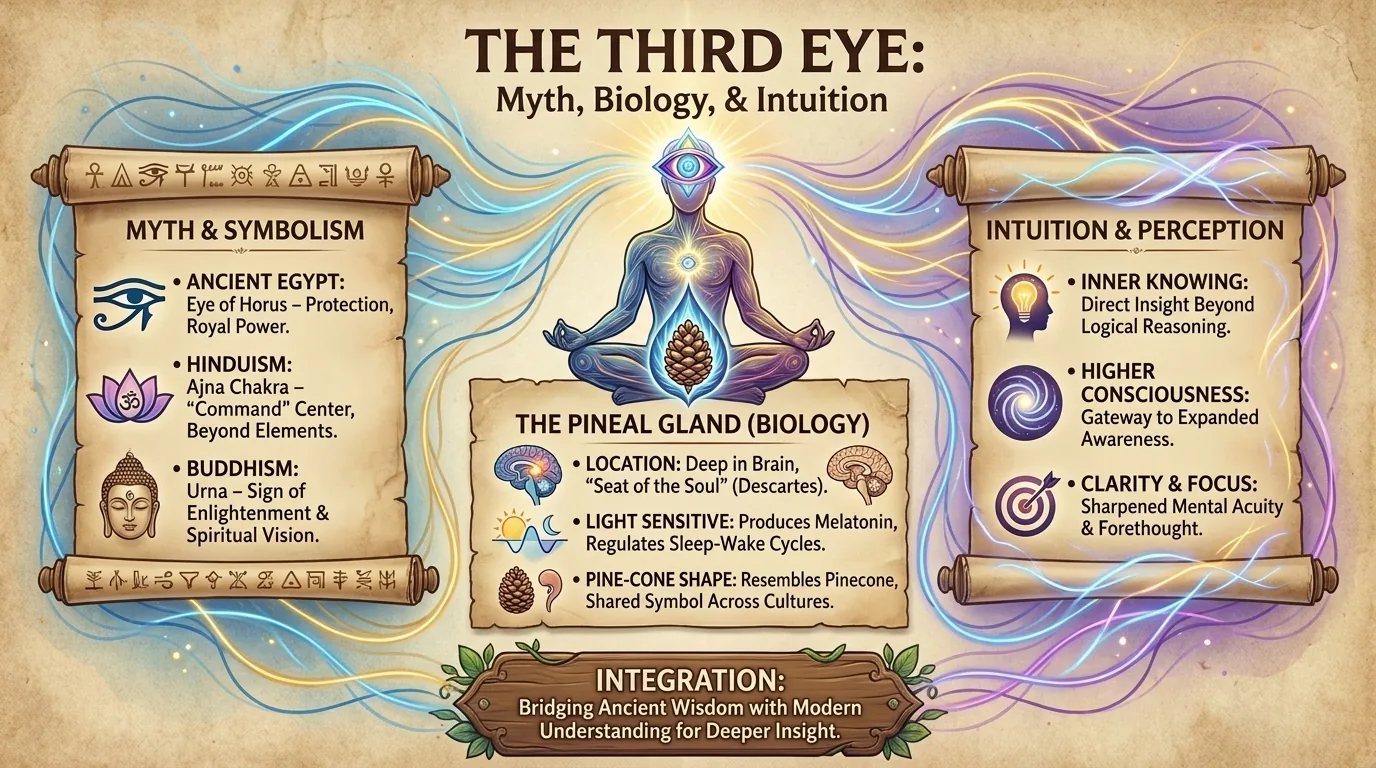
In the modern yogic tradition, the third eye chakra, called Ajna, is generally placed symbolically between the eyebrows.
It’s associated with discernment, intuition, concentration and a kind of knowing that doesn’t rely solely on verbal reasoning.
In many contemporary depictions, its color is indigo.
But a huge misunderstanding quickly creeps in:
Ajna is not simply another ancient name for the pineal gland.
That association is largely modern.
So we need to separate three subjects that often get mixed up:
- the spiritual tradition of the Ajna chakra;
- the actual biology of the pineal gland;
- the subjective experience of intuition and inner visualization.
What does the Ajna chakra really represent?
The Sanskrit word ājñā can be translated as “command,” “authority” or “perception,” among other meanings.
In tantric and yogic systems, Ajna holds a special place because it represents a center of awareness, discernment and integration.
Its symbolic location between the eyebrows probably explains much of its modern association with the idea of a “third eye.”
It isn’t necessarily an invisible eye watching ghosts in your living room.
In a more contemplative reading, the third eye symbol mainly stands for inner vision.
Observing your thoughts.
Seeing a repeating pattern.
Recognizing an intuition.
Developing concentration.
Telling perception apart from projection.
That last skill is especially important.
The more interested you become in spiritual intuition, the more you also need to learn to recognize your own biases.
Otherwise, every impression instantly becomes “a message.”
And your brain, which already churns out associations all day long, suddenly gets promoted to cosmic intelligence agency.
A little discernment never hurt anyone’s third eye.
What does the pineal gland actually do?

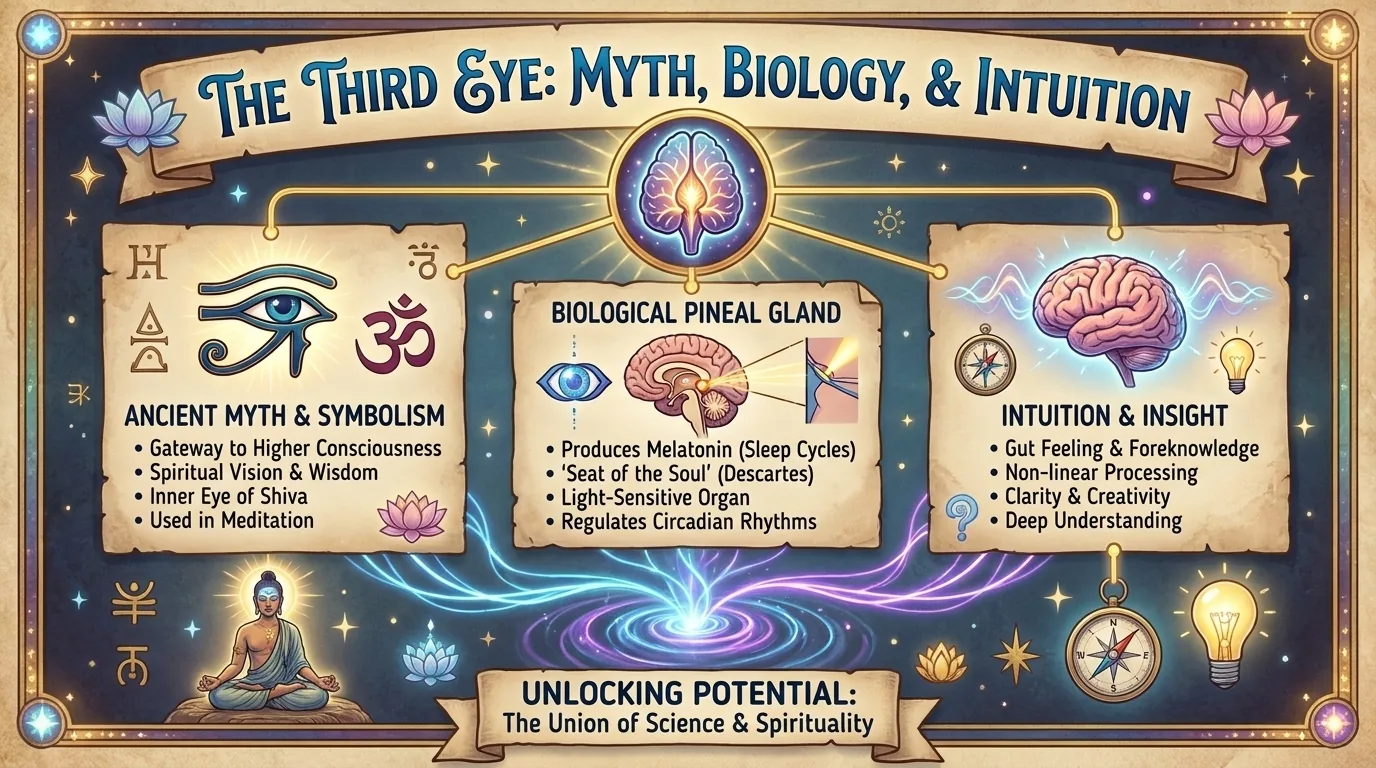
The pineal gland is a small endocrine structure located deep in the brain.
Its best-established function is producing melatonin, a hormone that plays a central role in regulating circadian rhythms and the sleep-wake cycle.
Melatonin secretion normally rises when your surroundings get dark and falls in the presence of light.
That’s why evening light and your light exposure habits can affect your body clock.
What science does not show, however, is that the pineal gland works as an organ of clairvoyance.
The pineal gland–third eye link is fascinating historically and symbolically, but we should avoid turning an analogy into a biological fact.
René Descartes himself gave the pineal gland a special philosophical role, seeing it as the place where body and soul interact.
The idea was historically important.
It doesn’t match modern neurobiology.
Likewise, the presence of light-sensitive cells in some species, or the evolutionary quirks of related structures, doesn’t prove that humans have a spiritual eye hidden in the brain.
The pineal gland is interesting enough as it is, without adding a premium psychic subscription.
Is pressure between your eyebrows one of the signs your third eye is opening?
Not necessarily. Many people practicing third eye meditation report a feeling of pressure, warmth, tingling or pulsing in the forehead area.
This can be interpreted spiritually as Ajna activating.
But there’s also a much simpler explanation.
When you focus your attention intensely on one area of the body, you become more sensitive to sensations you’d been ignoring until then.
On top of that, some people unconsciously tense their forehead muscles when they try to “look” mentally between their eyebrows.
Try it now.
Focus really hard on the middle of your forehead.
You may notice a little tension appear.
There you go.
Your third eye isn’t necessarily downloading an update.
It may just be your muscles at work.
That doesn’t make the meditation useless.
Quite the opposite.
The sensation becomes an excellent focus point if you observe it without immediately giving it some extraordinary meaning.
Why do you see lights and colors behind your eyelids?
Another common phenomenon: seeing lights, shapes, colors or patterns with your eyes closed.
These experiences can have several perfectly normal origins.
Phosphenes are perceptions of light that appear without any direct external light source.
Spontaneous activity in the visual system can also produce shapes and textures, especially when your eyes have been closed for a long time.
As you drift toward sleep, hypnagogic images can appear spontaneously.
Some visual concentration practices like trataka, which traditionally involves gazing at an object or a flame and then possibly observing its afterimage with your eyes closed, can also produce particularly vivid visual phenomena.
So in a third eye practice, the most useful rule is to observe before you interpret.
You see a blue light?
Note:
“blue light.”
Not straight away:
“My consciousness has just crossed into the sixth dimension.”
Maybe.
But let’s start with “blue light.”
It’s excellent mental discipline.
How does intuition actually work?

Intuition is probably the area where spirituality and psychology can have their smartest conversation.
The brain constantly processes huge amounts of information without every calculation becoming conscious.
It recognizes faces.
Tones of voice.
Habits.
Anomalies.
Probabilities.
Someone experienced in a field can sometimes “sense” that a situation is off before being able to explain exactly why.
That’s not necessarily paranormal.
It can be the result of very fast pattern recognition built up through experience.
An experienced doctor can spot something unusual.
A chess player sees a dangerous position.
A musician hears a wrong note instantly.
Someone who knows a person very well notices right away:
“Something’s not right.”
This kind of intuition is real and perfectly compatible with a scientific view.
Meditation can help develop it indirectly by improving your ability to notice internal signals, emotions, tiny bodily reactions and fast thoughts.
But you need to keep a second skill going alongside it:
checking.
Intuition + checking = discernment.
Intuition without checking = sometimes an excellent recipe for telling yourself stories.
How do you do a simple 10-minute third eye meditation?
Sit down comfortably.
Close your eyes.
Start with two minutes of natural breathing.
Then gently place your attention at the center of your forehead, slightly above the line of your eyebrows.
Don’t tense your muscles.
Don’t try to see anything.
For three minutes, simply observe whatever sensations are there.
Next, imagine a small point of light.
It can be blue, indigo, white or no particular color at all.
For three minutes, practice holding the image without forcing.
If it fades, calmly create it again.
Finally, for two minutes, let every image go and simply observe whatever shows up on its own.
Thoughts.
Shapes.
Sensations.
Silence.
Finish by bringing your attention back to your feet and your whole body.
This last step matters.
A good third eye meditation doesn’t need to leave you mentally floating in space for three hours.
The ability to come back counts as much as the ability to explore.
Frequently asked questions
Does the third eye really exist?
The third eye exists as a spiritual and symbolic concept in several traditions. Science has not identified any human organ allowing extrasensory perception that literally matches this concept.
Is the pineal gland the third eye?
Not in the scientific sense. The pineal gland is an endocrine gland mainly involved in producing melatonin and regulating circadian rhythms. Identifying it with the third eye comes mostly from modern philosophical and spiritual comparisons.
Why do I feel tingling between my eyebrows during meditation?
Focusing your attention heightens your perception of local sensations, and slight muscle tension can also cause pressure or tingling.
Can you develop your intuition with meditation?
Meditation can improve awareness of your sensations, emotions and inner reactions, which can help you pick up on certain intuitive signals. That doesn’t mean every intuition is accurate or paranormal, though.
Practice with the app
- Chakras
- Qigong
- Qigong meditation: feel the Qi, no experience needed
- Guided third eye meditation on the Ajna chakra
Rather practice than read?
Everything in this article can be practiced in MeditaDream, a free meditation app: 144 guided meditations and 17 immersive worlds, with no subscription, no ads, no account, and fully offline.