Daily meditation: how to make the habit stick
Daily meditation without forcing it: how to meditate daily, choose the right time, anchor it to an existing habit and handle unmotivated days.
The hardest part of meditation isn't meditating — it's coming back tomorrow. Building a daily meditation habit comes down to the moment you choose, the habit you anchor it to, and the size of the first step. Here's how to start meditating daily without forcing it.
How do you keep a daily meditation routine, wherever you are?
💼 How can you meditate at work?
- Transitions: 3 conscious breaths between two tasks or before each meeting — the brain closes one file before opening another, instead of stacking.
- The irritating email: never answer on the first wave. STOP (1 min), then answer — or better, RAIN first if the wave is big.
- Meditative single-tasking: pick a 25-minute task and do it as a meditation: a single window, notifications off, and return to the task at each distraction, as you return to the breath.
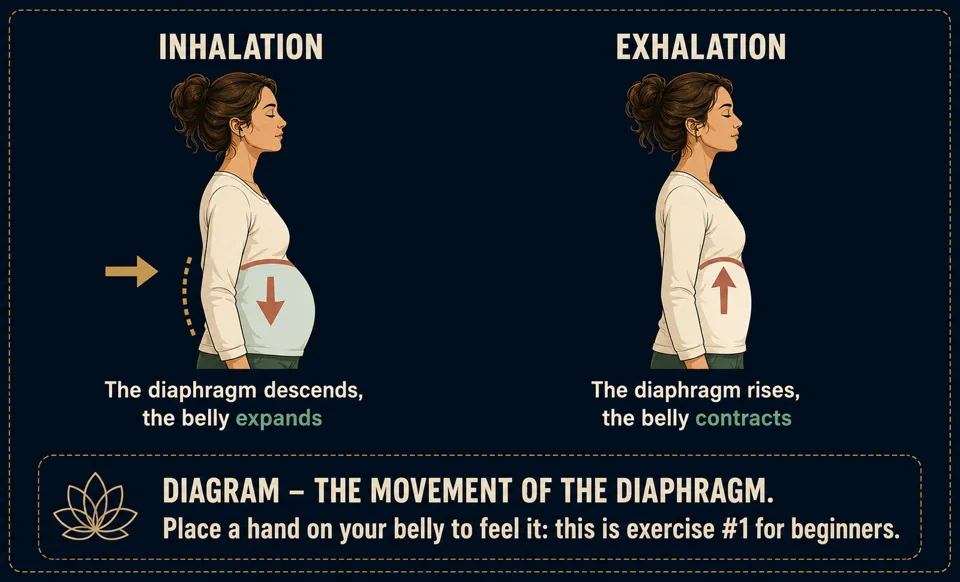
- The screen break: every hour, 20 seconds of looking into the distance + 3 abdominal breaths. Your eyes and vagus nerve will thank you.
📚 How can meditation help with studying and exams?
- Before a study session: 5 minutes of mindful breathing — stabilized attention upstream pays off every minute after.
- Stage fright: the day before, visualization (the “safe place,” then the exam scene unfolding calmly); just before the test, box breathing 4-4-4-4 or a physiological sigh.
- Going blank: during the test, if everything freezes: put down the pen, do a quick 5-4-3-2-1 (3 things seen, 2 heard, 1 touched), resume. 30 seconds that save 30 minutes.


🏃 How can meditation help before, during and after exercise?
- Before effort: a few abdominal breaths + a lightning scan (contact points, shoulders, jaw) to start relaxed.
- During: endurance is a ready-made moving meditation — the rhythm of steps or pedal strokes as anchor, exactly as in walking meditation.
- After: body scan in recovery accelerates relaxation; the still-warm body makes sensations very readable — ideal for progressing in body awareness.
- Competition: visualization of the successful move + a fixed breathing routine before each performance (the consistency of the ritual matters as much as the technique).
👨👩👧 How do you meditate with children?
Children meditate willingly if it's short, concrete and playful. Golden rule: about one minute per year of age, and always offer, never impose.
- The breathing plush (ages 3-6): lying down, a plush on the belly — make it rise and fall gently with the breath. It's abdominal breathing, disguised as a game.
- Inner weather (age 4 and up): “what's the weather like inside?” Sun, clouds, storm? You observe the weather, you don't punish it — first lesson in emotional recognition.
- The listening minute (age 5 and up): eyes closed, raise your hand when you can no longer hear the bell (or bowl). Then: “how many different sounds did you hear?”
- For teens: offer the micro-practices useful for THEIR concerns (stage fright, sleep, class focus) rather than “meditation” in general — use creates buy-in.
🚇 How can you practice mindfulness on the go and around screens?
- Subway, bus, train: perfect sound meditation (the din becomes your focus) or anchor on the body's contact points and sway.
- Lines: rename them “free breaks”: feet on floor, breath, shoulders. Impatience itself is an excellent object of observation.
- Attentional hygiene: every reflex phone unlock is anti-meditation training. A simple counterweight: one conscious breath before unlocking. You'll see how many times your hand moves on its own — that's already mindfulness.
Frequently asked questions
What's the best time of day to meditate?
The one you can keep. Morning anchors the habit before the day overflows; in the evening, a guided sleep meditation prepares deep sleep. What matters is regularity, not the hour.
How long should a beginner meditate?
Five minutes is enough — a short meditation you finish beats a long one you abandon. Four-minute sessions exist precisely for busy days.
How to make meditation a habit and stop quitting?
Attach it to an existing habit (after coffee, before the shower), keep a record of your sessions, and allow two-minute days. The chain is what counts, not the performance.
How to start a daily meditation practice?
Pick one moment you can keep every day, and start with five minutes rather than twenty. Keep the same spot and the same cue for two weeks, until it feels automatic. In the free MeditaDream app, a dragon companion grows with every minute you meditate, a small reason to come back tomorrow.
Practice with the app
Rather practice than read?
Everything in this article can be practiced in MeditaDream, a free meditation app: 144 guided meditations and 17 immersive worlds, with no subscription, no ads, no account, and fully offline.