How to be happier: what positive psychology says we can really learn
Can you learn how to be happier? What positive psychology research really shows, why the 40% rule is too simple, and a 30-day training plan to try.
Is happiness genetic, or is it a choice?
Neither, entirely: positive psychology research suggests that part of it depends on you, and part of it doesn’t. We talk about happiness as something we have or lose:
“I’m happy.”
“I’m not happy anymore.”
As if it were a mysterious object hidden somewhere between the right relationship, the right job, the right house and a sufficiently reassuring bank account.
Conversely, part of the personal development industry offers exactly the opposite excess:
“Happiness is a choice.”
This phrase can be attractive when everything is going relatively well.
It becomes significantly less convincing in the face of:
- illness;
- grief;
- financial insecurity;
- violence;
- depression;
- deep loneliness.
The scientific reality probably lies somewhere in between.
Our well-being depends at the same time on relatively stable individual characteristics, on our living conditions, our relationships, our health and certain behaviors or psychological strategies that can be modified.
In 2005, Sonja Lyubomirsky, Kennon Sheldon and David Schkade proposed a model that became extremely influential, distinguishing in particular genetic factors, circumstances and intentional activities; their central idea was that certain voluntary practices could support lasting changes in well-being despite hedonic adaptation, this tendency to gradually get used to many improvements or deteriorations in life. (Sage Journals)
In that model, the genetic part is often called the happiness set point: a baseline we tend to drift back to.
The model has often been summarized in the press by overly rigid percentages, sometimes as if exactly 50% of happiness was genetic, 10% circumstantial and 40% entirely under your control.
This interpretation is far too simplistic.
Happiness is not a pre-cut cake.
But the important intuition remains valid:
certain dimensions of well-being can be trained.
Not all.
Not without limits.
But enough for the question to deserve better than a simple “you are either born happy or you are not.”
Can you be happy and still feel sad?

Yes. The first skill of happiness is to stop asking it to be a permanent emotion. Imagine your definition of happiness:
feeling good all the time.
If that’s the criterion, you’ve already lost.
A normal human organism goes through:
- joy;
- fatigue;
- irritation;
- fear;
- sadness;
- boredom;
- desire;
- relief.
Trying to eliminate all unpleasant emotions sometimes creates exactly the opposite effect: we begin to view every moment of sadness as proof that something is not right in our life.
Psychological well-being is more like an ability to experience a full range of emotions while maintaining direction, relationships and meaning.
You can be deeply happy with your life and sad today.
You can love your family and be mad at them on Tuesday night.
You may have chosen a job that suits you and still want to throw your computer out the window at 4:42 p.m.
The skill therefore consists less in constantly producing joy than in reducing the confusion between:
“I feel an unpleasant emotion”
and
“my life is going badly”.
This nuance connects with meditation and mindfulness approaches: observing an emotion as a transitory state sometimes prevents it from immediately becoming an identity or an overall conclusion.
“I feel anxious”
is different from
“I am an anxious person incapable of being happy”.
Only one word changes.
But psychologically, a lot of things change with it.
Do positive psychology exercises really work?
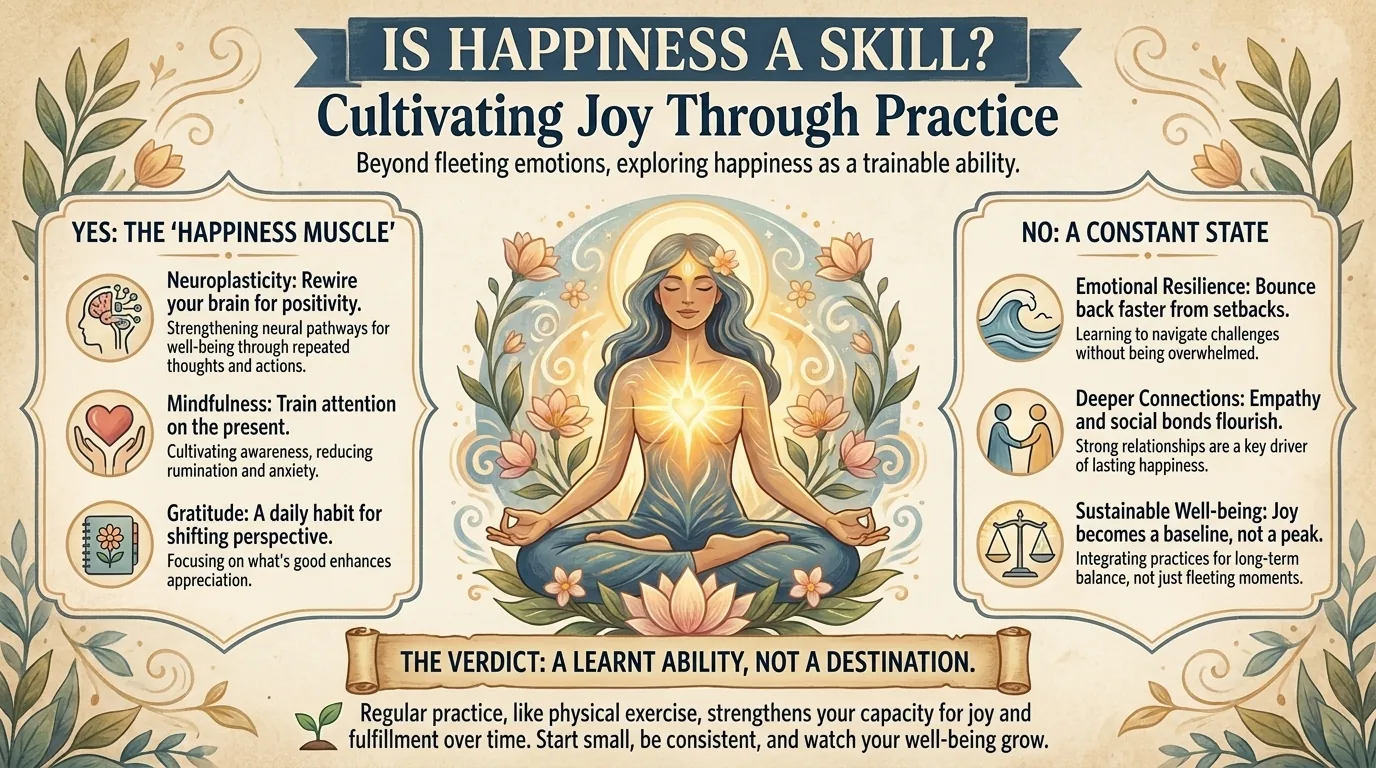
Yes, modestly — which is already a lot. Positive psychology has developed a whole family of interventions:
- gratitude;
- identification of strengths;
- acts of kindness;
- visualization of a better future;
- mindfulness practices;
- work on meaning;
- positive relationships.
A classic 2013 meta-analysis of randomized controlled trials found modest effects on subjective and psychological well-being as well as a reduction in depressive symptoms, while reporting strong heterogeneity, differences in methodological quality and signs of publication bias. (PubMed)
A recent systematic review published in 2026, covering the literature between 2000 and 2025, also concludes that positive psychology interventions produce on average modest favorable effects on subjective well-being, life satisfaction and positive affect, with particularly promising results for approaches integrating gratitude, personal strengths and mindfulness; the authors, however, highlight persistent methodological limitations. (PubMed)
This is almost the best news possible.
Why?
Because a modest effect means you don’t need to believe that three lines of gratitude will revolutionize your existence.
They may simply shift the average slightly.
And a slight improvement repeated over several years can be very important.
We tend to look down on small effects because we want a spectacular transformation.
But a life is mostly made up of ordinary days.
Improving an ordinary day by a few percent might ultimately be more useful than getting two extraordinary retreats per year.
Which happiness skills matter more than “thinking positive”?

If we were to condense much of the science of well-being into trainable skills, four dimensions would be particularly interesting: attention, relationships, action aligned with your values and recovery.
The first is attention.
What you never notice produces little conscious experience.
You can have an objectively pleasant day and mentally spend the entire afternoon focusing on the one frustrating event.
Meditation, gratitude or certain contemplative practices teach precisely how to intentionally shift some of your attention.
The second is the relationship with others.
Research on well-being regularly highlights the major importance of social ties, support and relational quality.
You can optimize your morning routine to an almost Olympic level; if you are deeply isolated, the problem is probably not that your water is missing lemon.
The third is action aligned with your values.
Some activities are enjoyable while they are being done.
Others mostly give meaning after the fact.
Learning a language, helping someone, raising a child, building a business or running a marathon isn’t necessarily enjoyable every minute of it.
But a satisfying life is not about maximizing immediate pleasure.
The fourth is recovery.
Sleep.
Rest.
Physical activity.
Moments without stimulation.
An exhausted brain has a surprisingly different view of the world than the same brain rested.
Happiness is therefore perhaps less a state to be sought directly than an ecosystem to be maintained.
Can trying too hard to be happy make you less happy?
Yes, it can. Suppose that every evening you write down your happiness:
Monday: 7.8.
Tuesday: 7.2.
Wednesday: 6.9.
On Thursday you start to panic:
“My happiness is decreasing!”
By monitoring the desired state, you turn every normal variation into a problem.
It’s the same paradox as with sleep.
The more happiness becomes an obligation, the more every ordinary moment feels like a failure.
However, life has a lot of emotionally neutral moments.
Doing the dishes.
Waiting.
Walking to the subway.
Replying to an email.
You don’t need to reach contemplative ecstasy at every pedestrian crossing.
A good life can contain a lot of neutrality.
It can even contain really difficult periods.
This is why the search for well-being benefits from moving from:
“Am I happy now?”
to:
“Does my way of living reasonably create the conditions for a life that suits me?”
More useful questions:
Am I getting enough sleep?
Do I see the people who matter?
Do my days contain something that matters to me?
Do I have time with no obligations?
Does my work constantly drain my energy?
Can I feel a difficult emotion without immediately trying to numb it?
Happiness stops being a smile.
It becomes an architecture.
What does a realistic 30-day happiness challenge look like?
For thirty days, do not measure your “happiness level.”
Simply train four behaviors.
Every day:
Attention — consciously notice one genuinely pleasant thing.
It does not have to be extraordinary.
Sunlight.
A meal.
A conversation.
A hot shower.
Then:
Connection — one act of connection.
A sincere message.
A phone call.
Listening without your phone.
Next:
Meaning — one action, however small, connected to something that matters to you.
Learn.
Create.
Help.
Build.
Finally:
Recovery — a genuine period with no productivity.
Walking.
Rest.
Meditation.
Reading.
After thirty days, ask yourself only three questions:
What genuinely improved my days?
What was I doing only because an article said it was supposed to work?
Which habit deserves to stay?
That is the skill part.
Not being cheerful on command.
Gradually learning:
- where to place your attention;
- which relationships to nurture;
- which activities feel meaningful;
- how to protect your energy;
- how to move through emotions you do not like.
Happiness is probably neither entirely chosen nor entirely imposed.
It is more like navigation.
You do not choose:
- the weather;
- the wind;
- the sea;
- the boat you were given at the start.
But some people gradually learn to use the helm better.
And sometimes, that already makes an enormous difference.
Frequently asked questions
Can you really learn to be happier?
Some psychological interventions can modestly increase average well-being, but the effect varies depending on the person, living conditions, and the practices used. (PubMed)
Is happiness 50% genetic?
Genetic factors play a role in differences in well-being, but the percentages popularized from older models should not be interpreted as fixed and unchangeable quotas for each individual.
Which habits seem most useful?
Evidence supports certain practices involving gratitude, mindfulness, the use of personal strengths, and relationship-building, with effects that are generally modest rather than miraculous. (PubMed)
Should we try to be positive all the time?
No. Psychological well-being also involves the ability to recognize and move through sadness, fear, anger, and frustration without automatically treating their presence as a failure.
Practice with the app
- Immersive worlds
- Visualization
- Guided nature meditation in sacred places
- Guided visualization meditation to train your inner eye
- Guided story meditation: one place, one time, one story
Rather practice than read?
Everything in this article can be practiced in MeditaDream, a free meditation app: 144 guided meditations and 17 immersive worlds, with no subscription, no ads, no account, and fully offline.